The math sheet is on the table. Your 7-year-old reads the first problem, and before the pencil has touched the paper — maybe eight seconds in — you hear it: "Can I just ask ChatGPT?" Nothing is written. If your kid won't try homework before asking ChatGPT, you've probably already said "try first" a dozen times, and it's clearly not landing. The problem usually isn't defiance. It's that "try" doesn't mean anything yet.
Here's the fix in one line: define "try" so concretely your child can point at it, then run the same short script every homework night until it's boring.
Save this graphic
Pin it to your "Parenting & Kids" board so the script is there the next time the pencil hasn't moved and the request comes anyway.
More parenting + AI content on Pinterest → Parenting in the Age of AI
Why "just try first" bounces right off
To an adult, "try first" is obvious. To a 7-year-old, "try" is a feeling, not a measurement. They looked at the problem. It looked hard. In their honest accounting, that was trying — and now they're asking for help, exactly as told. You're both following the rule as you each understand it, which is why the argument goes in circles.
Now add the tool. A chatbot is fast, it never sighs, and it answers in a confident voice whether or not it's right. The pull toward "just ask it" is real, and the guide's first habit applies here as much as it does at the tablet: name the pull before you name the limit — the same acknowledge-first move that defuses "but everyone uses ChatGPT for homework".
Step one: define "try" so a 7-year-old can point at it
The guide's house norm is short: homework — try first, then help. It only works with the second half attached: define "try" in your house — how many problems, how many minutes — and write it down so nobody has to guess.
Pick one of two shapes:
- A count: "Two problems on paper before any help." The attempt has to be visible — pencil marks, a crossed-out guess — not a stare.
- A timer: "Five minutes on your own, then we look together." Younger kids often do better with a timer because it ends on its own.
Write the definition on the same card as the rule, where homework happens. When the request comes at second eight, you're no longer arguing about effort. You're pointing at a number: "What does our card say? Two problems. I see zero." That's a much smaller fight — and, like the rest of the family's AI house rules, one your kid can enforce on themselves.
The three-move script for the moment
Here's what to say when the request comes before the pencil moves. Short on purpose: calm and repeatable beats persuasive.
Say the true thing about why asking is tempting.
"You really want to just ask it. Homework feels slow compared to a screen — that's just true."
That's the guide's homework-night opener with the noun swapped. You're conceding, out loud, that the worksheet is the slower, harder thing — so your kid no longer has to argue the point.
The rule stays put. The next step is theirs.
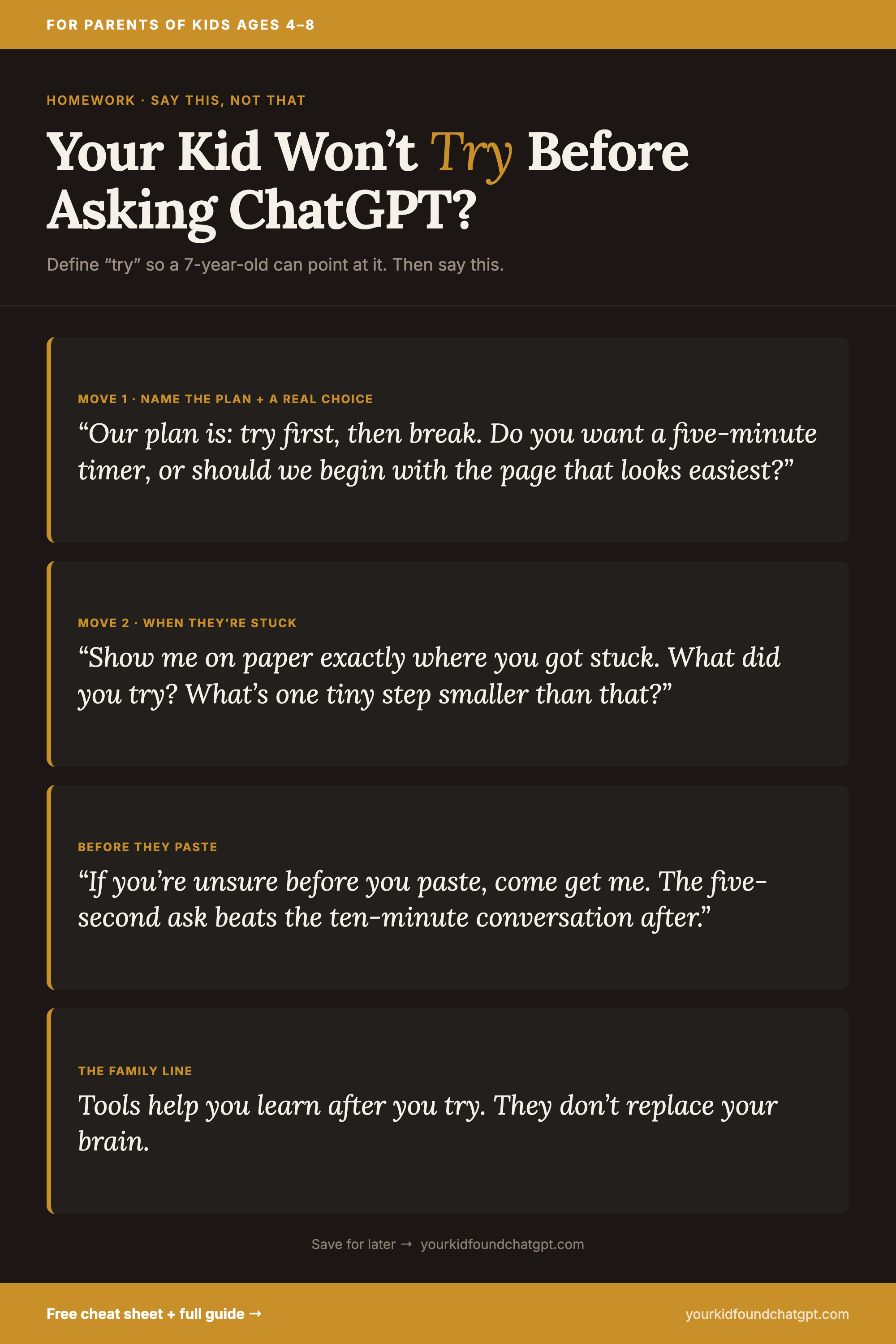
"Our plan is: try first, then break. Do you want a five-minute timer to start, or should we begin with the page that looks easiest?"
Both options start the trying; neither opens ChatGPT. But timer-or-easiest-page is genuinely theirs, and that small piece of control turns "no" into "not yet" — the same reason a real choice inside a limit ends the tablet fight.
Make the try visible, then shrink the problem.
"Show me on paper exactly where you got stuck. What did you try? OK — what's one tiny step that's smaller than what you just tried?"
"On paper" means the attempt has to exist somewhere you can see. "One tiny step smaller" turns stuck into a problem with a next move — you're shrinking the question, not answering it.
Then — the part parents skip — if they genuinely tried and are genuinely stuck, help is allowed. That was the deal. Try-first isn't a trick to make homework harder; it keeps the thinking in your kid's head instead of the chatbot's.
Get the 1-Page Cheat Sheet for Your Fridge
The 5 house rules, the green/yellow/red homework system, and 5 word-for-word scripts — all on one printable page. Free.
No spam. One email with the cheat sheet PDF. That's it.
What "help after trying" actually looks like
This is where ChatGPT comes back into the room — on your terms. The guide sorts homework help into green, yellow, and red zones, and AI-after-trying sits in yellow: step-by-step hints after written tries, with a parent available. "Write my paragraph for me" and "answer all the worksheet questions" stay red, tried or not, because they produce the final product without your child doing the thinking.
The kid-height version is the guide's definition of a homework helper: a tool that explains a step after you try first. In our family, it doesn't do the work for us. A 6-year-old can hold that sentence; they cannot hold a lecture.
One more line from the guide's pushback scripts — it quietly makes asking you the fast path:
"If you're unsure before you paste, come get me. The five-second ask beats the ten-minute conversation after."
When it's been thirty minutes and the page is still blank
Sometimes the problem isn't that they asked ChatGPT — it's that they didn't ask anyone. The temptation is a label — lazy, not trying — and labels turn the conversation into a defense of who they are, which you will never win. Be the camera instead:
"I see a blank worksheet and it's been thirty minutes." (pause) "What's happening?"
Usually the answer is "I don't understand this part," which drops you straight back into Move 3. The same describe-then-pause approach keeps things calm when you find AI-written text in a finished assignment.
Practice it when nothing is at stake
The hardest place to install a new habit is the night it matters — big worksheet, tired kid, tired parent. The guide's seven-day plan puts try-first on Day 2 for a reason: pick one low-stakes homework task, practice "try first" with a short timer, and celebrate the attempt, not the result.
If the only praise on offer is for right answers, a chatbot will always look like the better route to it. Praise the two problems on paper — including the wrong ones — and trying becomes the thing that pays. A few rounds on easy work, and the script above stops being a negotiation and becomes a routine.
What you're actually teaching
Underneath the timer and the two-problem rule is one sentence the guide suggests repeating until your kid can say it back: Tools help you learn after you try. They don't replace your brain. Boring on purpose — a child can remember a sentence that short.
The skill that matters isn't avoiding powerful tools; it's knowing the order — think first, then reach for help — and telling when a tool is teaching them versus doing it for them. A 7-year-old who learns that on a math worksheet is learning it on the cheapest version of the problem. That's the win, even on the nights it looks like a fight about a pencil.
Frequently asked questions
Why won't my kid try homework before asking ChatGPT?
Usually because "try" hasn't been defined. To a 7-year-old, reading the problem and finding it hard already feels like trying, so asking for help is them following the rule as they understand it. Add a fast, confident tool that never sighs, and the shortcut wins by default. The fix is to make "try" countable — a number of problems or minutes, written down — and to acknowledge the pull before you restate the rule.
How do I define "try first" for a young child?
Pick a shape your child can point at: a count ("two problems on paper before any help") or a timer ("five minutes on your own, then we look together"). The attempt has to be visible — pencil marks, a crossed-out guess — not a stare. Write the definition on the same card as the rule and keep it where homework happens, so the conversation becomes "what does our card say?" instead of an argument about effort.
What do I say when my child says "I'm stuck, I can't do this"?
Ask them to show you: "Show me on paper exactly where you got stuck. What did you try? OK — what's one tiny step that's smaller than what you just tried?" "On paper" makes the attempt visible, "what did you try" assumes there was one, and "one tiny step" turns stuck into a problem with a next move. If they genuinely tried and are genuinely stuck, help is allowed — that was the deal.
Is it OK for my kid to use ChatGPT for homework at all?
Yes, in the right order. Step-by-step hints after written tries, with a parent available, sit in the yellow zone of the green/yellow/red homework system — not the answer, just the next step. "Write my paragraph for me" or "answer all the worksheet questions" stay red no matter how much they tried, because they skip the thinking entirely. The kid-height version: a homework helper explains a step after you try first; it doesn't do the work for you.
Your Kid Found ChatGPT. Now What?
Six conversation habits, word-for-word scripts, the complete green/yellow/red homework system, and a 7-day family onboarding plan. Written for parents of kids 4–8.
Get the guide — $19 →