The problem with most parenting advice about AI is that it tells you what to believe, not what to say.
You know ChatGPT can be misused. You know homework is supposed to stretch your kid's brain. You know shortcuts feel good in the moment but don't build anything. But when your 7-year-old looks up from the laptop and says "ChatGPT already did it, it was faster," you blank.
These five scripts are designed for exactly that moment — the one you didn't see coming, the one where you have about eight seconds before you say something you'll regret or that will start a 20-minute fight.
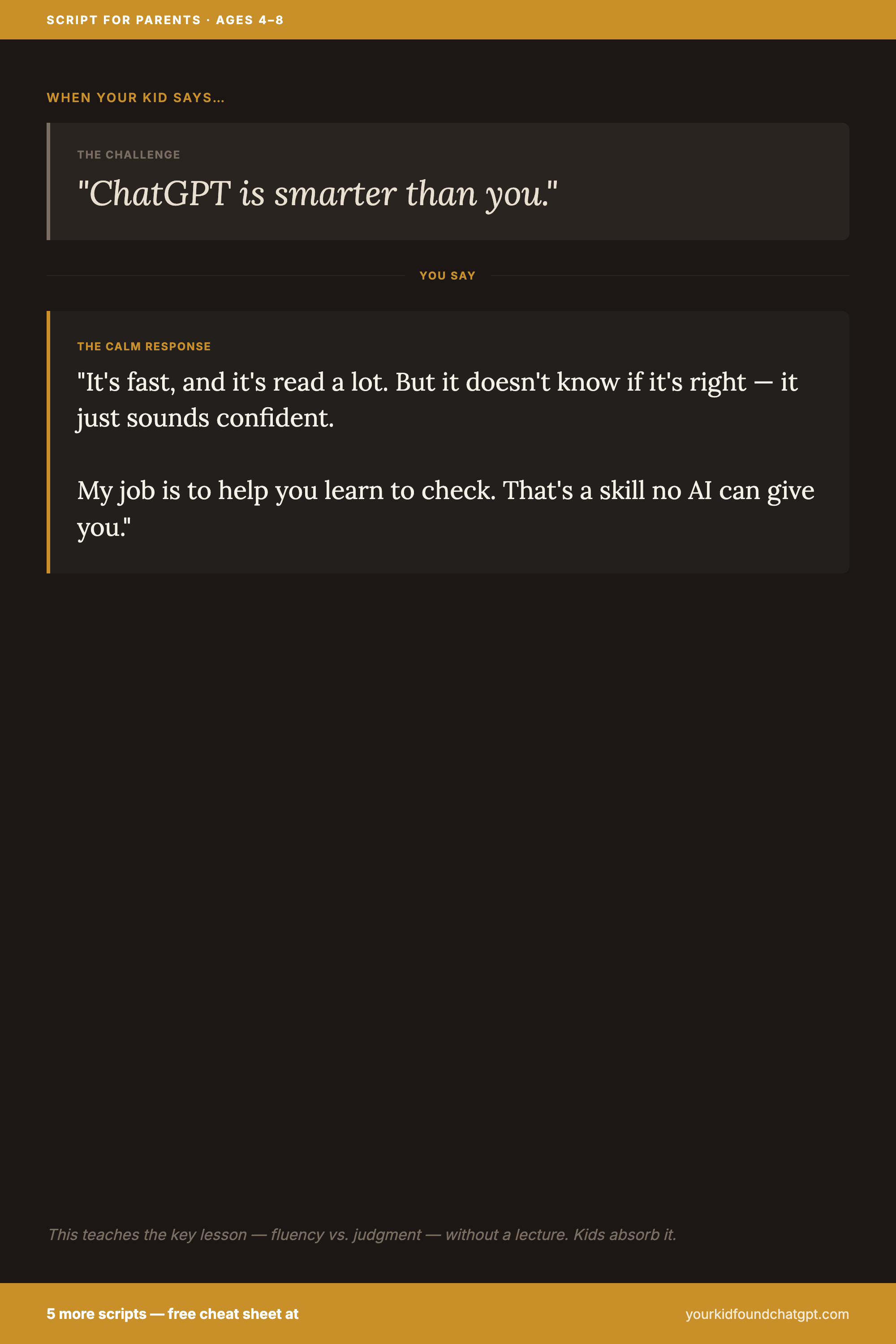
Save this graphic
Pin the before/after script card to your parenting board — or screenshot it to keep in your phone's camera roll for the next homework night.
More on Pinterest → Parenting in the Age of AI
The 5 scripts
Each one follows the same format: what you'd probably say (Before), what actually works (After), and why the shift matters.
Why it works: You're not lecturing — you're asking. The kid has to answer, which means they have to think through the logic themselves. They almost always land on "she wouldn't be learning what I can do" without you having to say "cheating."
Why it works: You're not defensive, and you're not dismissing AI. You're teaching a real concept — AI confidence vs. AI accuracy — in terms your kid can actually repeat. This one lands harder the first time a kid catches ChatGPT making something up.
Why it works: You're not attacking the friend or making your child defend someone. You're asking about the outcome they actually want — and "learning" vs. "just the grade" is a distinction your kid can make themselves if you give them space to.
Why it works: This is identity, not compliance. It's also impossible to argue with, because it shifts the frame from external rules to internal character. Kids ages 6–8 are deeply motivated by who they are — "I'm the kind of person who..." is surprisingly powerful at this age.
Why it works: You're taking the struggle seriously instead of dismissing it. "It's supposed to be hard" is true but lands as uncaring. "Show me where you're stuck" is a partnership — and the conditional AI use models exactly the kind of tool judgment you want them to develop over time.
Get All 5 Scripts on One Printable Sheet
The full cheat sheet includes all 5 scripts, the green/yellow/red homework system, and the 5 house rules — one page for the fridge. Free.
No spam. One email with the cheat sheet PDF. That's it.
The principle behind all five scripts
You'll notice a pattern: each script avoids "because I said so" in favor of a question or a reframe. That's intentional.
Rules enforced by authority hold only as long as the authority is present. Reasoning that kids internalize — the essay is about what you can do; ChatGPT doesn't know if it's right; integrity isn't about whether you get caught — holds as long as they remember the thinking. Which tends to be much longer.
You're not trying to win the argument. You're trying to give your kid a mental model they can apply the next time, when you're not in the room.
When scripts feel too scripted
If saying these word for word feels unnatural, don't. These are starting points, not performances. Adapt to your voice, your kid, your specific situation.
What matters isn't the exact words — it's that you're responding with curiosity and a question rather than a rule and a consequence. That small shift changes the whole tenor of the conversation, and it compounds: each time you respond this way, your kid learns that AI moments are something you can talk about, not just something to hide.
Building the habit
The families who navigate AI and homework well aren't the ones with the strictest rules. They're the ones who've had enough of these conversations that the conversations themselves become normal.
The first homework moment is awkward. The fifth is easy. The tenth, your kid might come to you with the question before you even need a script.
Your Kid Found ChatGPT. Now What?
Six conversation habits, all five scripts in context, the green/yellow/red homework system, and a 7-day family onboarding plan. Written for parents of kids 4–8.
Get the guide — $19 →