Most parents try to handle AI with a single, serious conversation. They sit the kid down, lay out the rules, feel good for an afternoon — and then nothing changes, because rules announced once don't become habits.
What actually works is closer to how you taught them to brush their teeth: a little, every day, until it's just how the family does things. So here's an AI family onboarding plan built that way — seven days, about ten minutes each, each day adding one small piece. By the end of the week you won't have a lecture your kid forgot. You'll have a routine they live.
This is the streamlined version of the onboarding plan from the full guide. Everything you need to do it is below; the printable templates it points to (the house-norms card, the homework poster, the caregiver one-pager) live in the guide itself.
Why seven days beats one talk
Young kids learn rules through repetition and ritual, not through a single download of information. Spreading the setup across a week does three things a one-time talk can't: it lets each idea sink in before the next arrives, it turns abstract rules into things your child made (a poster, a game, a role-play), and it gives you low-stakes reps before the first real homework conflict. Ten quiet minutes a day, and the rules stop being yours and start being theirs.
The plan, day by day
Make the rules together
Read your family's AI house norms aloud, together. Then hand your child the marker: have them draw or decorate "our family's rules" — a poster, a fridge card, anything. A rule a kid illustrated is a rule a kid remembers. (New to this? Start with the 5 AI house rules.)
Practice "try first"
Pick one low-stakes homework task. Set a short timer and practice attempting it before reaching for any help. Celebrate the attempt, not the result — you're teaching that the first move is always their own brain, and AI comes after.
Play the fact-check game
Give your child a silly, obviously-wrong definition of a word and have them correct you. Swap a few times. It's a giggly two minutes that builds the single most important AI instinct: confident-sounding answers can still be wrong, so we check. (More on that: when ChatGPT gets it wrong.)
Role-play the pushback
Two-minute role-play: your child pretends to push back on a rule, and you practice acknowledging the feeling first, then calmly holding the limit with a choice. Then swap roles and let them be the parent. Laughing is encouraged — you're rehearsing the hard moment while it's still a game.
Build the green / yellow / red poster
Make the homework "traffic light" together — green (AI is fine), yellow (ask first), red (do it yourself) — and hang it in the kitchen before the next homework night. Now the rule is on the wall, not in an argument. (Here's the green/yellow/red homework system.)
Loop in the other grown-ups
If grandparents, a sitter, or a co-parent ever supervise screen time, get everyone on the same page. A quick text with your house rules and your phone number is plenty. Consistency across caregivers is what keeps a six-year-old from finding the loophole.
Hold your first weekly check-in
Ten minutes, four questions: What did you use AI for this week? What's working? Where did it get tricky? What's one thing we'll try next week? Then end with something fun. This becomes your recurring rhythm — the engine that keeps the whole thing alive after the week is over.
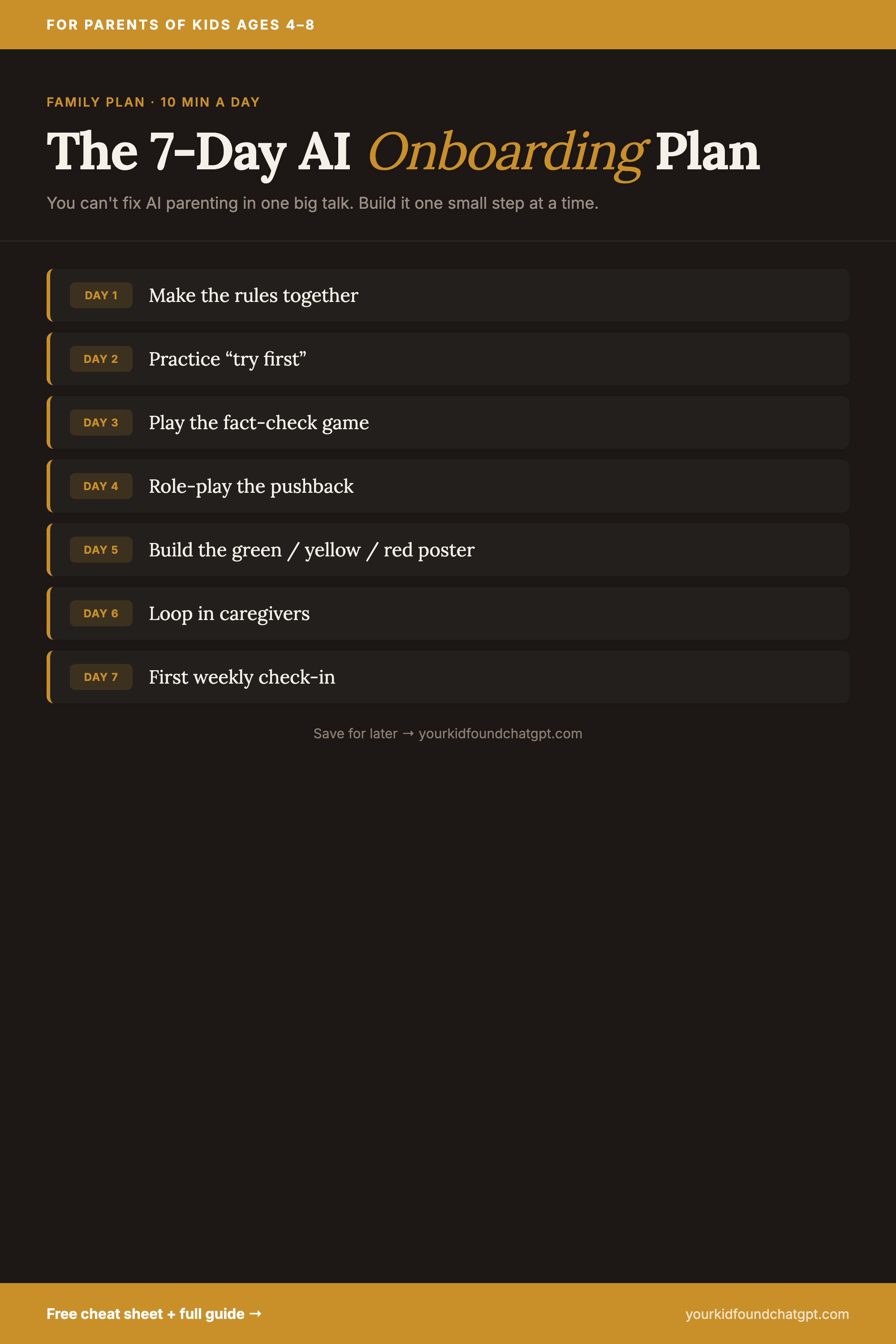
Save the 7-day checklist
Pin it to your "Parenting & Kids" board and tick off one day at a time — the whole week, one tap away.
More parenting + AI content on Pinterest → Parenting in the Age of AI
Get the 1-Page Cheat Sheet for Your Fridge
The AI house rules, the green/yellow/red homework system, and 5 word-for-word scripts — all on one printable page. Free.
No spam. One email with the cheat sheet PDF. That's it.
What makes it stick (and what to skip)
Two things separate the families who finish the week from the ones who fizzle on day three. First: keep each day to ten minutes. The plan works because it's small — the moment it feels like homework for you, it dies. Second: don't try to do all seven at once. The spacing isn't a limitation; it's the mechanism. One idea per day is how it moves from your head into their habits.
And the part most parents skip: the day-7 check-in isn't the finish line, it's the start of the routine. Keep it going weekly for a month, then monthly. A short log helps — when you look back in six months, you'll see far more progress than you felt in the moment.
"You can't lecture a kid into a good relationship with AI. You build it the same way you build any family habit — a little, out loud, together, every day for a week."
The short version
Seven days, ten minutes each: make the rules together, practice trying first, play the fact-check game, role-play the pushback, build the homework poster, loop in caregivers, and hold your first weekly check-in. That's the whole AI family onboarding plan — small enough to actually finish, structured enough to actually stick.
Get the printable plan + every template
This is the streamlined version. The full guide includes the printable 7-day checklist, the house-norms card, the green/yellow/red poster, the caregiver one-pager, the weekly check-in log, and word-for-word scripts — plus six conversation habits for parents of kids 4–8.
Get the guide — $19 →