It's 9:40 on a school night. The kids are finally asleep and you're doing the last sweep — lunchboxes, permission slips, the homework folder. You pull out your 7-year-old's reading response and start skimming. Then you stop. "Furthermore, the caterpillar's transformation demonstrates the importance of patience and perseverance." Your 7-year-old says "super-duper." Your 7-year-old has never once said "furthermore."
The stomach drop is real. You read it again, hoping you're wrong. You're not. You've just found AI-generated text in your child's homework, and every option that comes to mind first — march into their room, email the teacher, take the tablet forever — is a bad one.
Here's the good news: this moment goes fine when you do one specific thing first — and sideways when you open with the obvious question.
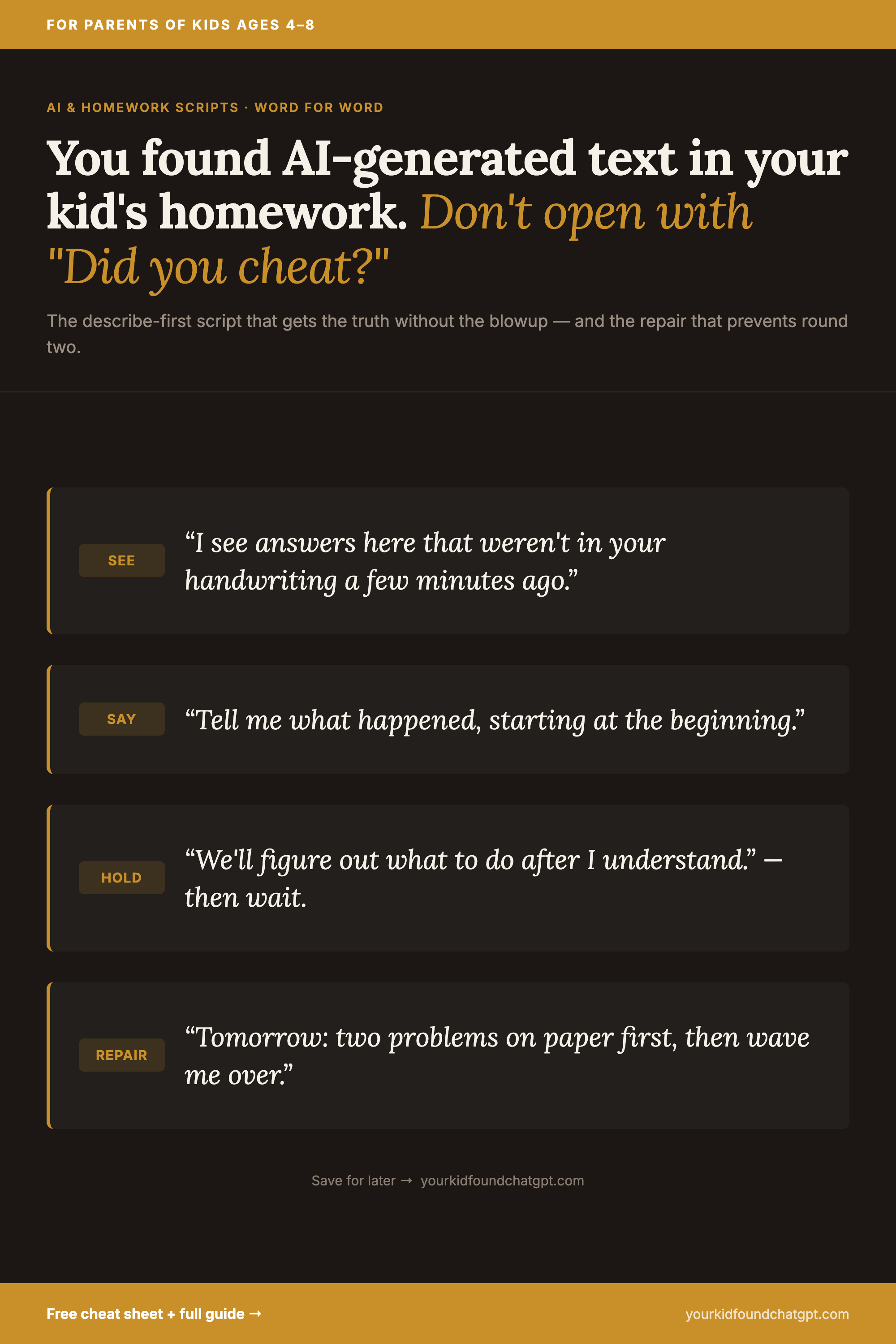
Save this graphic
Pin the four scripts to your "Parenting & Kids" board so they're one tap away the next time a homework page doesn't sound like your kid.
More parenting + AI content on Pinterest → Parenting in the Age of AI
"Did you cheat?" is a trap — for both of you
The obvious question feels responsible — direct, serious, on top of it. But it hands a scared 6- or 7-year-old exactly two options: confess to being a cheater, or lie. Most young kids under that pressure pick the lie — not because they're dishonest, but because the question just put their character on trial, and lying is the only door out of the courtroom.
Now you have two problems: the homework and the lie. Ten minutes in you're prosecuting trust — "why would you lie to my face?" — a fight with no winnable ending for either of you.
We covered the broader first-response playbook in what to do when your kid used ChatGPT on homework. Tonight you need the move for this specific scene.
Be the camera, not the judge
The move comes from Habit 2 of our guide: a camera describes; a judge evaluates. Scared, tired parents reach for labels — cheater, liar — and labels make a child defend who they are instead of addressing what they did. The camera flips it: describe what an impartial observer would see — the typed answers, the handwriting, the clock — without one word of evaluation. Then stop talking.
Say it quietly, sitting down, worksheet between you:
"I see answers here that weren't in your handwriting a few minutes ago." (pause) "That worries me. Tell me what happened, starting at the beginning. We'll figure out what to do after I understand what you were trying to solve."
Every word is doing work. "I see" reports instead of accuses. The pause — it will feel uncomfortably long — is where your child decides whether the truth is safe. And "what you were trying to solve" tells them you're both looking at a problem, not at a criminal.
The guide's note on this exact script: "The child has room to tell the truth. 'Liar' closes the door. Curiosity opens it."
If they admit it
Given the pause, most kids will — usually something like "I couldn't do it and the computer wrote it." Your job is to keep the admission cheap, because you want admissions to stay cheap for the next ten years. The guide's script for exactly this moment:
"OK. What happened? Let's talk through it. Mistake isn't the end—it's data. What do you know now that you didn't know before?"
Then the assignment gets redone — by them, with you nearby. That's the consequence, and it's enough. The redo says the learning still has to happen; a lecture on top says you're the kind of kid who cheats — the message that drives the next incident underground.
If they deny it
Sometimes you get a flat "I didn't do anything" while the evidence sits between you. Don't cross-examine — you can't interrogate a 7-year-old into honesty; you'll only train a better witness. Restate the observation once and build an off-ramp. (This script is our extension of the guide's camera principle — its rule, our words.)
"I'm not trying to catch you. I read it, and it doesn't sound like you — and it's okay to tell me that. Take a minute. I'll come back and ask one more time, and whatever the answer is, we'll handle it together."
If the denial holds, stop digging. The guide's if/then table is blunt: when lying about tool use shows up, pause the tool, repair, and tighten supervision — without a shame spiral. You don't need a confession to act on what you saw.
Get the 1-Page Cheat Sheet for Your Fridge
The 5 house rules, the green/yellow/red homework system, and 5 word-for-word scripts — all on one printable page. Free.
No spam. One email with the cheat sheet PDF. That's it.
The repair: four steps, five minutes
Whether they admitted it or not, the night should end the same way — with repair, not resolution. The guide's Habit 6 gives repair a simple four-part shape:
- Fact, not character: "The helper was used before the try-first step." — not "You cheated again."
- Impact: "That makes it harder for me to trust the homework plan."
- Next time: "Tomorrow we start with two problems on paper, then wave me over before touching the helper." — specific, doable, forward.
- Reconnect: snack, water, hug, a bad joke — whatever fits your kid. In the guide's words: "end on connection, not resolution. Resolution can wait. Connection cannot."
Opened with the interrogation anyway, before reading this? Repair runs in both directions. The guide's script for your own misstep:
"Hey. I got loud earlier in a way I didn't want to. I was frustrated and I didn't handle it well—that's on me, not you. Next time I'm going to take a breath before I respond. I'm working on it."
Preventing round two: make the line visible
Zoom out, and tonight probably happened for a boring reason: the line was never defined. Your child may genuinely not have known pasting AI answers was over it — the school policy is vague, and "the computer helped me" feels a lot like the spell-checker you're fine with.
The fix is the green/yellow/red system from Habit 5. Green: go with transparency — spell-check after a handwritten draft. Yellow: ask an adult first — hints after written tries. Red: not in our house — anything that produces the final product without your child's thinking. The full poster version is in the homework zone system; it works because the lines exist before someone crosses them, so you spend less time prosecuting and more time teaching.
Plant one line from the guide's scripts while you're at it:
"If you're unsure before you paste, come get me. The five-second ask beats the ten-minute conversation after."
You'll stand in this kitchen again — new tool, new worksheet, new paragraph that doesn't sound like your kid. That's fine. The interrogated child learns to hide better; the child who gets the camera learns the truth is survivable in your house. Run the describe-first script enough times and you're building the kid who tells you before you find it.
Frequently asked questions
How can I tell if my child used AI for homework?
With kids ages 4–8, the tell is usually voice, not software. Look for vocabulary your child doesn't use, sentence structure that jumps grade levels, work that appeared much faster than your child works, or typed text with no drafts or eraser marks behind it. You don't need a forensic case — describe what you noticed out loud and let your child fill in what happened.
What should I say when I find AI-generated text in my child's homework?
Describe exactly what you see, without a label, then pause: “I see answers here that weren't in your handwriting a few minutes ago. Tell me what happened, starting at the beginning.” Skip “did you cheat?” — an accusation makes a scared child defend their character, while a plain description gives them room to tell the truth.
Should I punish my child for using ChatGPT on homework?
A consequence, yes — punishment aimed at character, no. The assignment still gets redone by your child, and the tool can pause for a while, but the goal is repair: name the fact, name the impact, set a specific next-time plan, and reconnect. Shame teaches kids to hide AI use better; repair teaches them your family can handle mistakes.
How do teachers detect AI-generated writing?
Mostly the same way you just did — voice. Teachers read a child's writing all year, so vocabulary, polish, and structure that suddenly jump grade levels stand out immediately. Some schools also run AI-detection software, but those tools are widely known to misfire in both directions, which is why many teachers weigh a flagged piece against the writing samples they've watched the child produce in class.
Your Kid Found ChatGPT. Now What?
All six conversation habits — including the full camera technique, the green/yellow/red homework system, repair scripts, and a 7-day family onboarding plan. Written for parents of kids 4–8, for exactly nights like this one.
Get the guide — $19 →