It's a Tuesday night. The worksheet has been sitting there for twenty minutes, and your 7-year-old finally looks up and delivers the line they've clearly been saving: "Can I just use ChatGPT? Everyone uses it for homework." If you've been searching for what to say when "everyone uses ChatGPT for homework" lands in the middle of your kitchen, this is that script — word for word.
First, though: why the obvious answers make it worse.
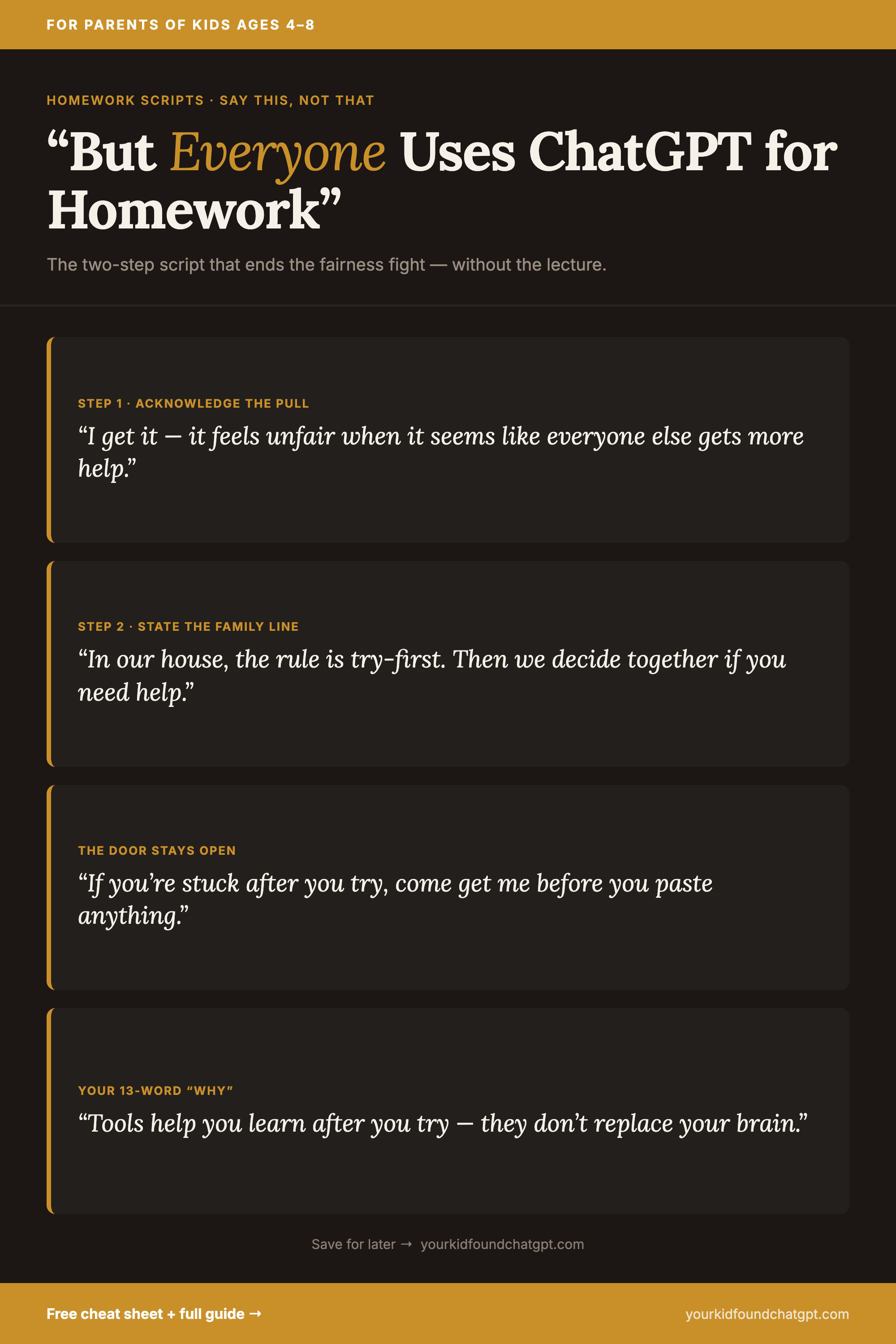
Save this graphic
Pin it to your "Parenting & Kids" board so the script is there the next time homework night goes sideways.
More parenting + AI content on Pinterest → Parenting in the Age of AI
Why "we don't care what other families do" backfires
Here's the version of this conversation most of us grew up with, and most of us reach for under pressure:
Parent: "We don't care what other families do. That's our rule."
Child: "It's not fair."
Parent: "Life isn't fair."
The parent won the exchange and lost the relationship point. Nothing was resolved — the kid just learned that the fairness feeling isn't safe to bring to you. Next time it won't come as a question. It will come as a hidden browser tab.
The problem isn't the rule. It's the sequence. When a child is in the grip of wanting something, the logical part of their brain isn't available for your explanation — the want is too loud. What cuts through isn't a louder reason. It's acknowledgment: brief, honest recognition that the feeling is real, even when the answer is no.
The two-step script
Here's the same moment, run in the right order — feeling first, then the limit:
Name the fairness feeling before you touch the rule.
"I get it — it feels unfair when it seems like everyone else gets more help. That's a real feeling, and I'm not going to pretend it isn't."
Then pause. Actually pause. You are not agreeing to give them the thing — you're proving that you heard them. Those are very different, and your child's nervous system knows the difference.
One sentence, same words every time.
"In our house, the rule is try-first, then we decide together if you need help. If you're stuck after you try, come get me before you paste anything."
Notice what this isn't: it isn't a ban, and it isn't a lecture about learning loss. It's a boundary with a door in it — AI help exists, but it comes after their own attempt and through you.
That's the whole script — two beats, maybe fifteen seconds. The magic isn't clever wording; it's the acknowledgment coming first and the rule staying identical every time.
Get the 1-Page Cheat Sheet for Your Fridge
The 5 house rules, the green/yellow/red homework system, and 5 word-for-word scripts — all on one printable page. Free.
No spam. One email with the cheat sheet PDF. That's it.
The sharper version: "I'm the only one who doesn't"
Sometimes the claim arrives with a knife in it: "Everyone uses ChatGPT. I'm the only one who doesn't." That version stings because it's not really about homework anymore — it's about belonging. Your kid is telling you they feel like the odd one out.
The response that works treats the difference between families as a fact, not a scandal:
"Some families draw the line in different places. Ours is try-first, then we decide together if you need help. If you're unsure before you paste, come get me. The five-second ask beats the ten-minute conversation after."
And when the follow-up question comes — "why do we have different rules than everyone else?" — that's not defiance either. It's a developmental question. Kids are building their map of how families work, and they've noticed the maps vary. Your answer doesn't have to be a TED talk. It has to be honest, short, and repeatable:
"In our family, tools help you learn after you try — they don't replace your brain."
That's thirteen words. A child can remember thirteen words. They cannot remember your seven-minute explanation of AI bias and long-term skill development. Pick your one line and say it every time — the same way you'd handle it when your kid calls you a hypocrite about screen time: honesty in kid-height vocabulary, repeated until it's boring.
Is "everyone" even true?
Probably not literally — "everyone" is a feeling word, not a headcount. But don't spend your energy fact-checking it, because two things are worth taking seriously underneath the exaggeration.
First, some classmates almost certainly are using AI on homework, with wildly different levels of adult involvement — your kid is reporting the playground version of a real thing. Second, the claim is information about your child, not the class: they've noticed AI is normal in their world, and they're checking where your family stands. A calm answer now is much cheaper than an awkward discovery later — and if you've already been through finding out your kid used ChatGPT on homework, you know what the expensive version looks like.
This is also why a standing family system beats improvising every night. If your house already runs the green/yellow/red homework zones, the "everyone uses it" argument gets shorter on its own — the question stops being whether AI is allowed and becomes which zone tonight's assignment is in.
When they keep pushing
Some nights the script lands and homework starts. Some nights you get round two: "But it's faster. But it's not cheating. But you don't get it." Here's the discipline: acknowledge once, state the line once, then stop talking.
Re-explaining is the trap. Every additional reason you offer reopens the debate and signals the rule might be negotiable tonight. If you need somewhere to put the energy, offer two real choices inside the rule instead:
"The homework helper comes after your own try on paper — that's our family line. Do you want to try two problems first, or read the directions out loud to me first to get unstuck?"
Then comes the hard part: the silence. Most parents fill it with more words or threats. Don't. The silence is uncomfortable, and it's where your child makes the decision. Most kids, eventually, pick one of the two options — because both options are real, and because the fight stopped being interesting the moment you stopped feeding it.
If you want more word-for-word language for the whole homework battlefield — the stuck moments, the sneaky paste, "the teacher didn't say we can't" — the companion piece is what to say when your kid wants ChatGPT to do their homework.
What you're actually teaching
Played right, the "everyone uses it" fight is a gift: a live chance to show that big feelings get heard in your house and the boundary holds anyway. That combination — warmth and firmness in the same fifteen seconds — is what makes the next conversation easier instead of harder.
You're not raising a kid who never uses AI. You're raising a kid who, standing in front of a tool you've never heard of three years from now, hears a boring thirteen-word sentence in the back of their head: tools help you learn after you try. That's the win. It just doesn't look like one at 7:40 on a Tuesday.
Frequently asked questions
What should I say when my kid says everyone uses ChatGPT for homework?
Acknowledge the feeling first, then restate your family line. Something like: "I get it — it feels unfair when it seems like everyone else gets more help. In our house, the rule is try-first, then we decide together if you need help." The order matters: feeling first, rule second. Skipping the acknowledgment is what turns the moment into a fight.
Is it actually true that everyone uses ChatGPT for homework?
"Everyone" is a feeling word, not a headcount. Some classmates probably do use AI on homework, with wildly different levels of adult involvement. You don't need to fact-check the claim to respond well — what your child is really saying is "I feel left out," and that's the part worth answering.
Should I just let my child use ChatGPT for homework like other families?
Other families' rules aren't your ceiling or your floor. A try-first rule — your child attempts the work before any AI help, and an adult stays in the loop — keeps the learning while still letting AI unstick them. For ages 4–8, any AI use should be parent-led anyway, so "like other families" rarely means unsupervised.
What if my kid keeps arguing after I give the script?
Acknowledge once, state the line once, then stop talking. Repeating the rule louder or adding reasons reopens the debate. A short silence feels uncomfortable, but it's where your child actually decides. If the arguing continues, offer two real choices within the rule — "try two problems first, or read the directions out loud to me" — and let them pick.
Your Kid Found ChatGPT. Now What?
Six conversation habits, word-for-word scripts, the complete green/yellow/red homework system, and a 7-day family onboarding plan. Written for parents of kids 4–8.
Get the guide — $19 →