The tablet has been on for its agreed half hour. You say it's time to stop, and your 5-year-old's whole body goes rigid: "Five more minutes. FIVE MORE MINUTES." Within thirty seconds you're in a full-volume standoff on the living room floor. If you've been hunting for how to say no to screen time without a meltdown, the fix isn't a firmer no or a better bribe — it's changing the shape of the no.
Here's the move, in one line: name the limit, then hand your child a real choice inside it.
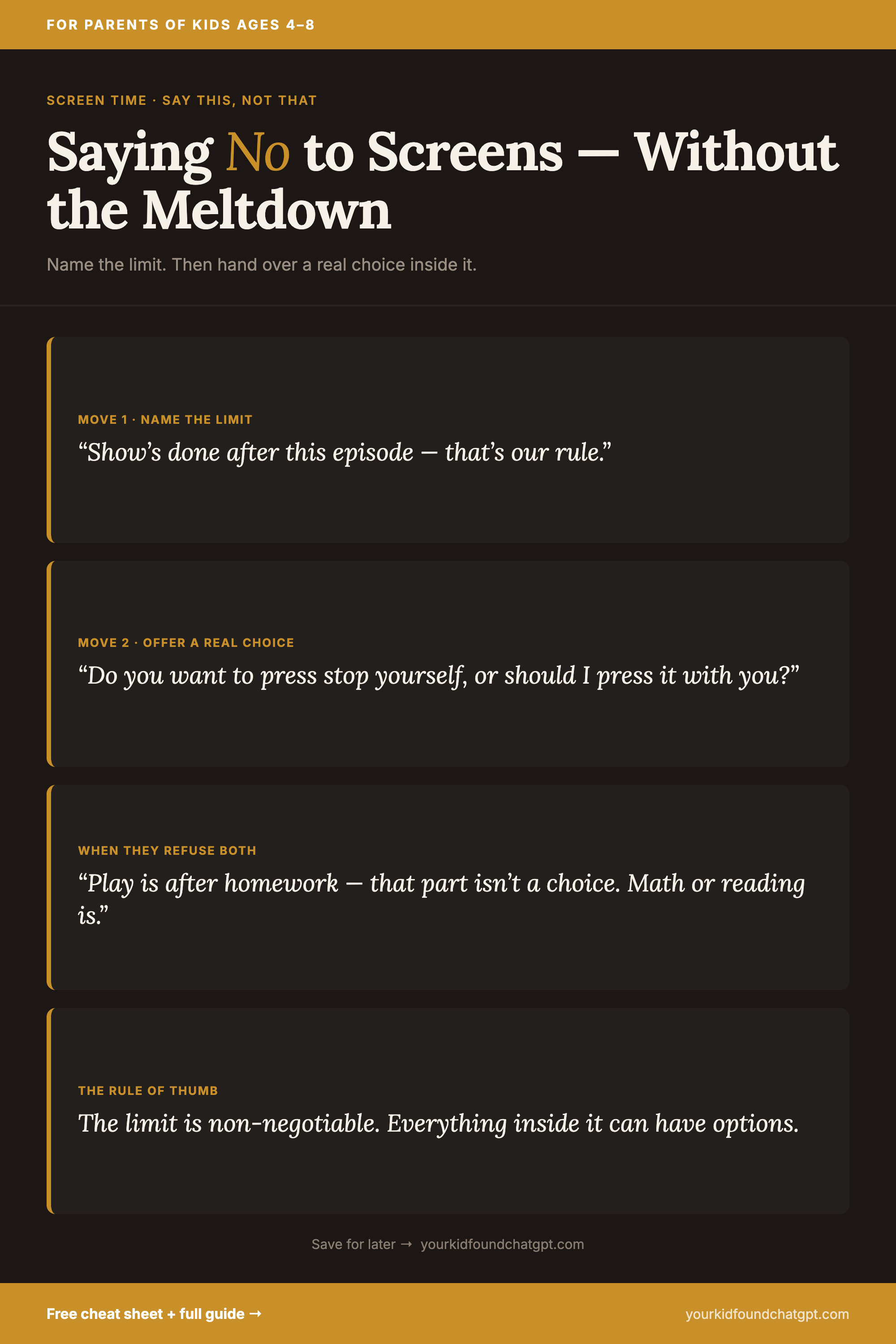
Save this graphic
Pin it to your "Parenting & Kids" board so the script is there the next time the tablet has to go off.
More parenting + AI content on Pinterest → Parenting in the Age of AI
Why "just turn it off" turns into a meltdown
The meltdown isn't really about the extra five minutes. It's about power. Kids ages 4–8 are deep in the work of building a sense of agency — their felt experience of having some control over their own life. When every limit arrives as a pure top-down decree, they fight it on principle. Not because they expect to win, but because powerlessness is genuinely uncomfortable, and a young nervous system pushes back against it hard.
Stack a second thing on top of that: the transition itself is a dip. Coming off a bright, fast, engaging screen into a slower room is its own small crash — which is why the whining so often lands right after the screen goes off. So the limit tends to arrive at the exact moment your child has the fewest resources to handle it. A decree with no give in it, delivered to a depleted kid, is a meltdown waiting to happen.
The counterintuitive part: giving your child more control is what makes the limit hold. Not control over whether it ends — control over how.
The two-move script
The whole technique is two beats: state the limit like weather, then offer two real options inside it. The limit doesn't move. Everything inside the fence can.
Say what's happening as a fact, not a plea or a threat.
"Show's done after this episode — that's our rule."
Notice the tone: it's the voice you'd use to say it's raining. Not angry, not begging, not "okaaay buddy, last one, I mean it this time." Apology and irritation both signal the line might move. A calm statement signals it won't — which, paradoxically, is what lets your child relax into it.
Hand over a decision your child actually gets to make.
"Do you want to press stop yourself, or want me to press it with you?"
Both options end the screen — that part is settled. But who presses stop is now theirs. It sounds tiny. It isn't. When a child enforces the rule themselves, they stop being the person the rule is done to and become the person doing it. That shift is the whole game.
That's it — maybe ten seconds. The magic isn't clever wording; it's the sequence. The fence goes up first and stays put, and then, only then, you open a small gate inside it.
Get the 1-Page Cheat Sheet for Your Fridge
The 5 house rules, the green/yellow/red homework system, and 5 word-for-word scripts — all on one printable page. Free.
No spam. One email with the cheat sheet PDF. That's it.
Real choices vs. fake choices
This only works if the choices are real — two options you can genuinely live with, both sitting inside the limit. The moment a "choice" smuggles a threat, your kid hears it instantly and the temperature goes up instead of down.
"You can turn it off now, or you can lose the tablet tomorrow."
That isn't two choices. It's an ultimatum wearing a choice costume, and a 5-year-old can smell it. Compare it to a genuine one, the kind that works just as well at the homework table as it does at the TV:
"Do you want to start with the math problems or the reading? Which one feels least terrible right now?"
Both of those are fine with you. Neither one lets your child out of the fence. That's the test for a real choice: could you cheerfully accept either answer? If one of the options is secretly the "wrong" one you're hoping they won't pick, it's not a choice — it's a trap, and it will read as one. This is the same limited-choices logic that defuses the "but everyone uses ChatGPT for homework" argument: the rule holds, and the child picks how they meet it.
When your kid refuses both options
Sometimes you'll offer two real choices and get a hard "no" to the whole menu: "I don't want to press stop OR have you do it. I want to keep watching." Here's the move — restate what isn't negotiable, restate the choice once, and then stop talking.
"I hear you. Play is after homework — that part isn't a choice. Math or reading is."
Then comes the hard part: the silence. Don't fill it. Most parents rush to add another reason, another warning, another "come on, we do this every day." Every extra sentence reopens the negotiation and tells your child the decision is still up for grabs. So you let it sit. The silence is genuinely uncomfortable — for you more than them — and it is exactly where your child makes the decision. Most kids, eventually, pick one of the two options. Not because you out-argued them, but because you stopped feeding the fight and left them a real, dignified way to step down.
And if it still tips over into a full meltdown some nights? That happens, especially when they're tired or hungry — and it's not a sign you did it wrong. Ride it out calmly; the repair comes after. If you lose your own cool in the process, that's recoverable too — here's how to repair after yelling about screens without turning it into a bigger deal than it was.
Make it easier on yourself: decide before the moment
The reason this script feels impossible in the heat of a tantrum is that you're composing it live, while a small person screams. So don't compose it live. Pick your recurring fight — the after-dinner tablet, the "one more episode," the tablet in the car — and write the limit and two real options down before it happens. Read them out loud a few times until the words feel natural in your mouth. That five minutes of prep is the actual practice; the calm you'll have in the moment is borrowed from it.
A few sentences you can keep in your pocket:
- The limit: "The tablet's done when the timer beeps — that's the rule."
- The choice: "Do you want to turn it off yourself or hand it to me?"
- The hold: "That part isn't a choice. This part is." (then quiet)
None of this makes your kid happy about the screen ending. That was never the goal. The goal is a no that holds without a war — a boundary with a small door in it, so your child gets to walk through instead of being carried.
What you're actually teaching
Played this way, the nightly screen handoff quietly teaches something bigger than "listen to me." It teaches that limits and choices can live in the same moment — that a boundary can be firm and still leave room for you inside it. That's a skill your kid will use on much heavier things than a tablet, for the rest of their life.
You're not raising a child who never hears no. You're raising one who learns that no isn't the end of their say — it's just the edge of it. That's the win. It rarely looks like one at 7 p.m. on a Tuesday, mid-negotiation, with the timer about to beep.
Frequently asked questions
How do I say no to screen time without a meltdown?
Name the limit calmly, then immediately offer a real choice inside it. The limit — "the show is done after this episode" — doesn't move. The choice — "do you want to press stop yourself, or should I press it with you?" — hands your child a piece of control they can actually use. Meltdowns spike when a no arrives as a pure top-down decree; a choice inside the boundary gives your child agency without opening the fence.
Why does my child melt down every time screen time ends?
For kids ages 4–8, powerlessness is genuinely uncomfortable — they're busy building their sense of agency, their felt experience of having some control over their own life. When every limit lands as a decree with no room inside it, they fight it on principle, not because they expect to win. The transition off a screen is also a real dip in itself, so the limit tends to land on an already-tired nervous system.
What are real choices versus fake choices?
A real choice is two options a parent can genuinely live with, both inside the limit: "do you want to start with math or reading?" A fake choice smuggles a threat: "do your homework now or face the consequences" isn't two choices, and kids hear the difference instantly. Fake choices raise the temperature; real choices lower it.
What do I do when my kid refuses both choices?
Restate what isn't negotiable, restate the choice once, then stop talking. Something like: "I hear you. Play is after homework — that part isn't a choice. Math or reading is." Then let the silence sit. Most parents fill it with more words or threats; don't. The silence is uncomfortable, and it's exactly where your child makes the decision.
Your Kid Found ChatGPT. Now What?
Six conversation habits, word-for-word scripts, the complete green/yellow/red homework system, and a 7-day family onboarding plan. Written for parents of kids 4–8.
Get the guide — $19 →