The moment usually looks like this: you walk past the kitchen table, glance at your 7-year-old's open laptop, and see a ChatGPT conversation on the screen. They look up. You freeze. And both of you wait to see what happens next.
Most parents get there without a plan. The guide they needed was a conversation they hadn't had yet — a simple set of shared expectations that make AI feel bounded and teachable instead of forbidden and sneaky.
These five house rules take about 10 minutes to introduce. Writing them down together is what makes them stick.
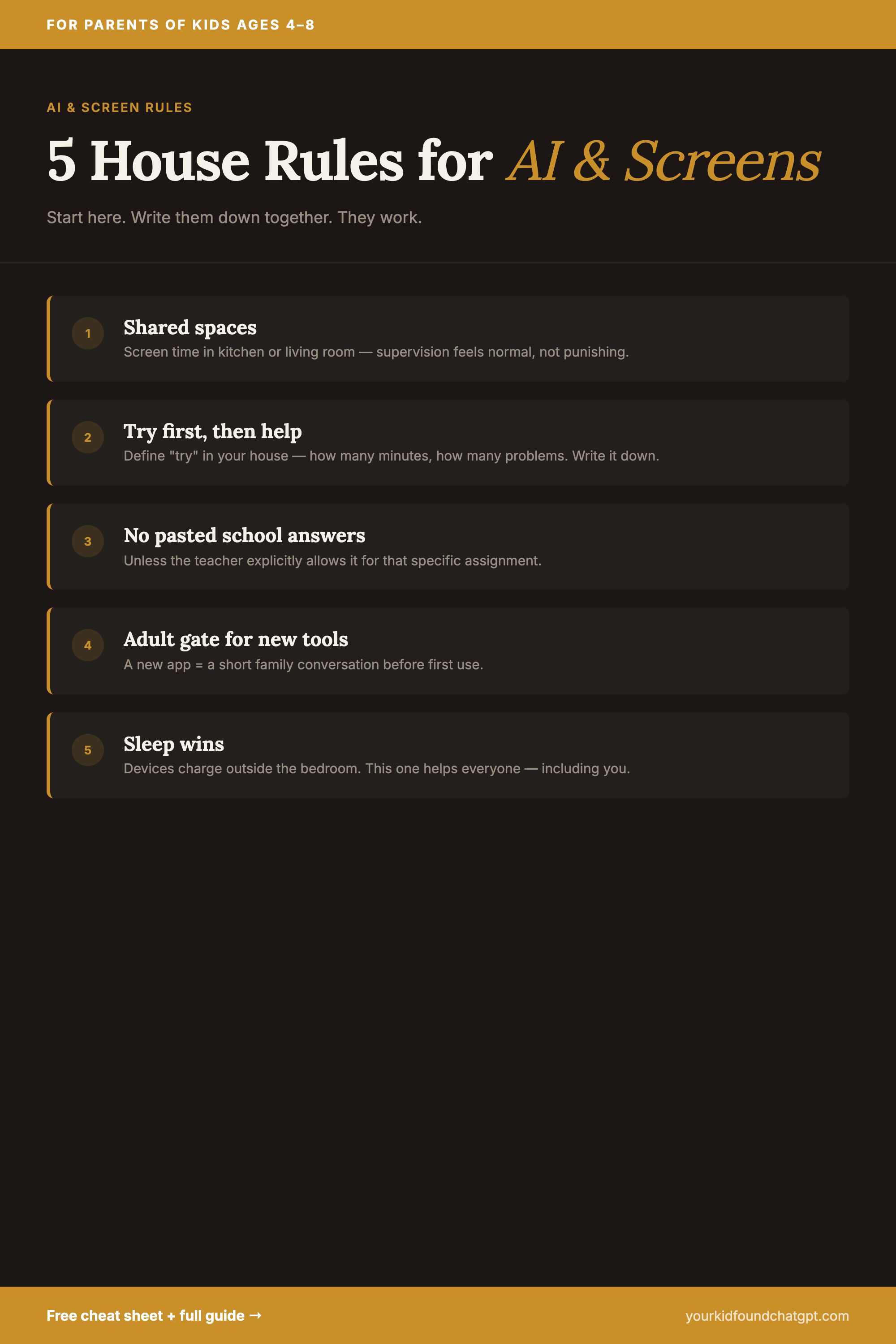
Save this graphic
Pin it to your "Parenting & Kids" board for easy reference — or screenshot it to print and post on the fridge.
More parenting + AI content on Pinterest → Parenting in the Age of AI
Why family rules beat bans — every time
Banning ChatGPT doesn't work for the same reason banning sugar doesn't work: kids encounter it anyway, just without the context. A rule-based approach teaches children how to use tools — a skill they'll carry for the rest of their lives.
Research on media literacy consistently shows that kids who have explicit household conversations about screen use develop better self-regulation than kids who hit hard walls. The goal isn't less AI — it's AI your kid knows how to handle.
The 5 rules
Shared spaces — AI conversations happen in the kitchen or living room, never behind a closed bedroom door.
This isn't surveillance. It's making the norm visible. When questions come up ("wait, did it just make that up?"), you're nearby. The rule also lowers stakes for your child: they're not hiding anything, so they're more likely to come to you with weird AI moments.
"When we use tools that talk back, we use them where the family can see. Same reason we don't do homework under the covers."
Try first, then ask — before opening ChatGPT, your child should attempt the problem on their own.
You define "try" together — a specific number of minutes, a specific number of problems. Write the definition down with the rule. This keeps AI as a scaffold rather than a shortcut, and it's especially important for math and writing where the struggle itself is the learning.
"ChatGPT can help unstick you, but only after you've tried. How many minutes counts as really trying? Let's decide together."
No pasted school answers — unless a teacher explicitly says a specific assignment is AI-assisted, your child writes their own work.
This is the most important academic integrity rule. Frame it in terms of what they're building, not what they're hiding: kids internalize "your teacher wants to see what your brain can do" far better than "it's cheating."
"Your teacher is trying to see what you think. If you paste an AI answer, she never actually sees you."
Adult gate for new tools — before your child uses any new AI tool for the first time, they ask first.
Five minutes at dinner counts. This isn't gatekeeping — it's modeling. You're showing your kids what it looks like to be thoughtful about tools before adopting them. It also keeps you informed without requiring constant monitoring.
"New app = short family conversation before first use. That's our rule."
Sleep wins — devices charge outside the bedroom.
Screen use — AI or otherwise — in the hour before sleep degrades sleep quality for everyone. Bedroom charging removes the temptation loop ("just one more question...") and creates a natural end to the AI day. This one benefits you too.
"Devices charge in the kitchen. This helps everyone sleep better — including me."
Get the 1-Page Cheat Sheet for Your Fridge
The 5 house rules, the green/yellow/red homework system, and 5 word-for-word scripts — all on one printable page. Free.
No spam. One email with the cheat sheet PDF. That's it.
How to introduce these rules without a fight
The key word is together. Don't announce the rules — build them together. A Saturday morning conversation that starts with "I've been thinking about how we should handle AI stuff, and I want to hear what you think" will land far better than a decree.
After the conversation:
- Write the rules down on paper — let your child do the writing if they're old enough.
- Post them somewhere visible: fridge, above the homework desk, inside the pantry door.
- Revisit them when something comes up — not as punishment, but as a reference.
"What does our rule say?" is a much easier conversation than "why did you do that?"
When rules get tested
They will. Your child will paste an AI answer, test the bedroom rule, or argue that "everyone does it." This is completely normal.
What matters is that you have a framework to return to — not a fight about right and wrong, but a reference to shared expectations you wrote together. The framework also makes it easier to update rules as your children grow and as AI tools evolve. Rules you wrote with an 8-year-old might need revisiting by age 10.
"The goal isn't a kid who follows your rules. It's a kid who, when they encounter a new AI tool you've never heard of, can ask themselves: does this fit our family's values?"
Start with one rule
If introducing all five at once feels like too much, start with Rule 1 (shared spaces). It's the lowest friction and highest visibility. Once that's normal, layer in Rule 2. The sequencing matters less than starting.
The families who do well with AI aren't the ones with the most restrictive rules. They're the ones who talked about it before it became a problem.
Frequently asked questions
What are good AI rules for kids?
Effective AI rules are simple, enforceable, and written down together. The five that work best for ages 4-8: keep AI use in shared family spaces, try the work yourself before asking AI, an adult sees anything AI helped with, AI is a helper not a friend, and screens and AI stop before bed. Fewer, clearer rules beat a long list nobody remembers.
Should I ban ChatGPT for my child?
For most families a flat ban backfires. Bans teach kids to hide use rather than think about it, and they remove your chance to model good judgment. Clear house rules — where, when, and how AI is allowed — keep you in the conversation and tend to hold up far better than prohibition.
At what age should kids use AI like ChatGPT?
OpenAI's terms require users to be at least 13, and anyone under 18 needs a parent's permission. For ages 4-8, that means any use should be fully parent-led and supervised — you're driving, not handing over the keyboard. House rules matter most in these years because you still hold the structure.
How do I introduce AI rules without a fight?
Introduce them as a family agreement, not a punishment. Pick a calm moment (not mid-conflict), explain the why in kid-height words, and write the rules down where everyone can see them. Start with one rule, let it become normal, then layer in the next.
Your Kid Found ChatGPT. Now What?
Six conversation habits, word-for-word scripts, the complete green/yellow/red homework system, and a 7-day family onboarding plan. Written for parents of kids 4–8.
Get the guide — $19 →