It's 7:40 on a Tuesday. Your 7-year-old is on the second spelling word, you've just corrected a letter, and they don't even look up: "ChatGPT is smarter than you." Flat. Not a tantrum, a verdict. And it stings because part of you suspects they have a point. If your kid says ChatGPT is smarter than you, you're not the first parent to go to bed and type it into a search bar: my kid says ChatGPT is smarter than me.
Short version: don't argue the premise. They're half right, and that half is the opening. Concede the true part, name the part they can't see yet, then claim the job the chatbot can't do.
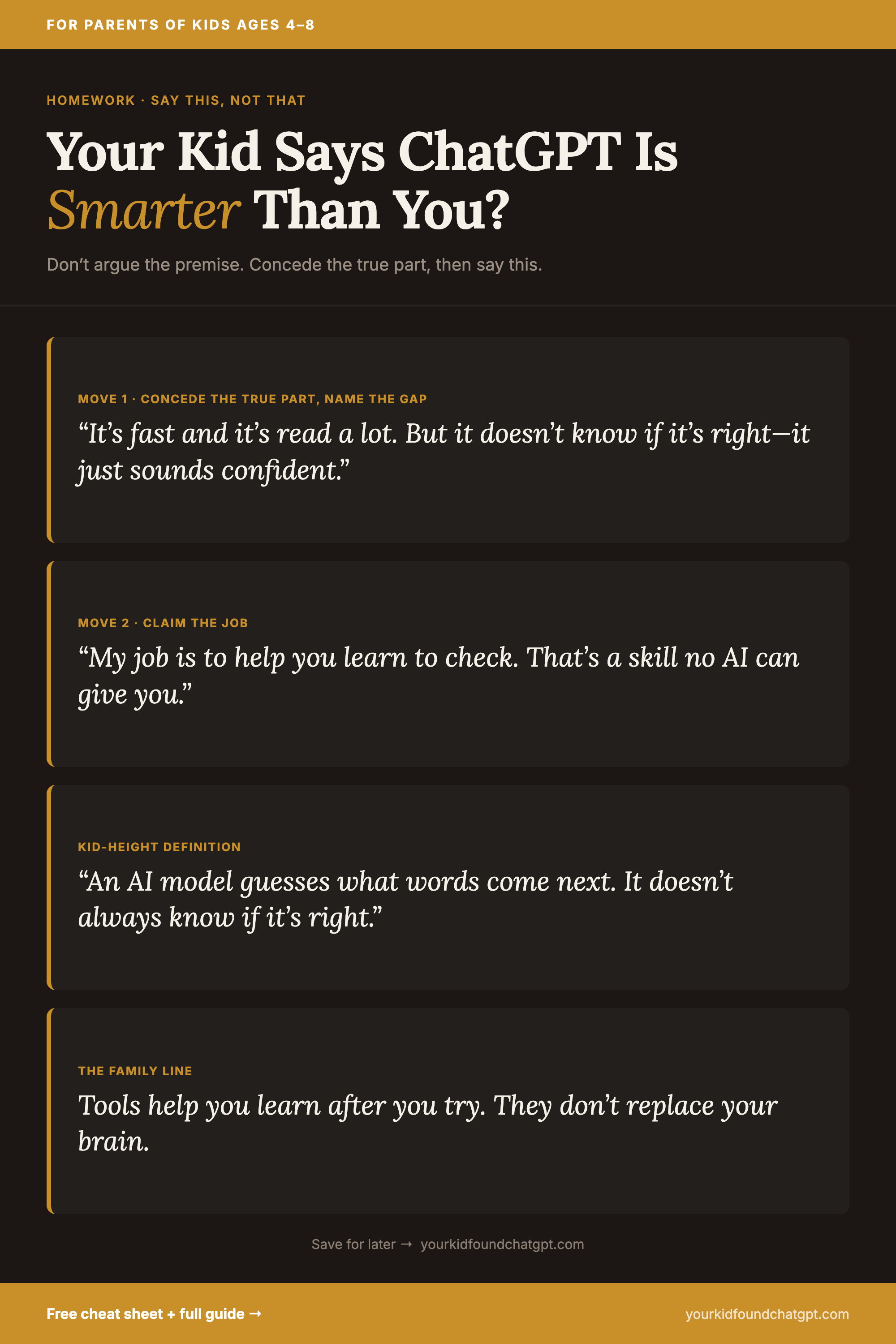
Save this graphic
Pin it to your "Parenting & Kids" board so the script is there the next time the verdict lands mid-spelling-list.
More parenting + AI content on Pinterest → Parenting in the Age of AI
Why this one stings (and why it isn't defiance)
"Smarter than you" lands differently than "five more minutes." It's aimed at you, and at the one thing you thought you brought to homework time. The first reaction is a defense, or a lecture on how computers work. Neither lands, for the reason the guide gives for every screen fight: in the moment, the want is too loud for a rebuttal.
Look at what your kid experienced. The chatbot answered instantly. It never sighed, never corrected a letter, never said "try again." As the guide puts it, for a kid who is anxious about performance, an AI that never judges is a relief. "Smarter than you" is often shorthand for "faster than you, and it doesn't make me feel wrong." That's not an insult. It's a report. And like "you're on your phone too," part of it is accurate observation.
Don't argue the premise
The losing move is debating who's smarter. You can't win it, because "smart" for a 7-year-old is one bucket that holds fast, confident, and correct all at once. The chatbot is reliably two of those three. Your kid can't yet tell which two, and that gap is the whole lesson. So split the bucket instead. The guide keeps one three-sentence script for exactly this moment.
The script: concede, name the gap, claim the job
Give them the point. Fast and well-read are real.
"It's fast and it's read a lot."
Seven words, and the argument is over before it starts. Your kid no longer has to defend the observation. It's the guide's first habit in a different outfit: acknowledge what's real first.
The part a 7-year-old can't see yet.
"But it doesn't know if it's right—it just sounds confident."
This sentence does the work. Every child knows a kid at school who sounds sure and is wrong. You've just taught confident versus correct without saying the word hallucination.
Smart was never the job. Checking is.
"My job is to help you learn to check. That's a skill no AI can give you."
You didn't claim to be smarter. You named a job the tool can't do and handed your kid the skill that goes with it. "Who's smarter?" becomes "who checks?", a question your kid can win.
Say it once, calmly, then move on. The tenth time, it stops being a comeback and becomes a family fact.
Get the 1-Page Cheat Sheet for Your Fridge
The 5 house rules, the green/yellow/red homework system, and 5 word-for-word scripts — all on one printable page. Free.
No spam. One email with the cheat sheet PDF. That's it.
Make "it just sounds confident" real
A 6-year-old will nod at "it doesn't know if it's right" and not believe you. They need to see it. The guide's kid-height vocabulary gives you the frame: an AI model guesses what words come next, and it doesn't always know if it's right.
So run a sixty-second check together. Ask the chatbot something only your family knows: the dog's middle name, what's in tomorrow's lunchbox. If it guesses, point at the guess: "See? It sounded sure. It didn't know." If it admits it doesn't know, that's a lesson too. Our explainer on what happens when ChatGPT gets it wrong covers the why without scaring anyone.
Keep the vocabulary stable, too. The guide's definition of a homework helper is a tool that explains a step after you try first. Call it "the helper" every time, and your kid stops hearing "the genius."
What "learn to check" looks like on a school night
You just claimed checking as your job. Here's where it lives. In the green/yellow/red homework system, step-by-step hints after written tries sit in the yellow zone: parent available, the thinking still in your kid's head. The helper suggests a step; a human decides if it's right.
One more line from the guide quietly makes asking you the fast path:
"If you're unsure before you paste, come get me. The five-second ask beats the ten-minute conversation after."
That puts you back in the loop as the checker, not the competitor, and it's the same line that anchors the try-first script for the night the pencil won't move. Then the family line, repeated until your kid can say it back: Tools help you learn after you try. They don't replace your brain. A child can remember thirteen words. They cannot remember how language models are trained.
When you actually got it wrong
Sometimes it comes right after you were wrong: you misread the problem, or the spelling word really was spelled their way. Don't dodge it. The guide's answer to the hypocrite accusation works because it's true, and so does this: "You're right, I got that one wrong. Good catch. Let's check the next one together."
That isn't losing. It's modeling the skill you just claimed as your job, and treating your child like someone worth being honest with.
If it keeps coming up
If it becomes a daily refrain, it's usually not about intelligence anymore. The guide names the feelings under a screen request: this is where I feel capable, this is where I'm not behind, this is where nobody tells me I'm doing it wrong. A chatbot that never judges can be a refuge for a kid who feels judged at homework time.
No therapy voice needed. One occasional acknowledgment that you see them, not just the screen: "Homework has felt hard lately, huh?" Then back to the plan. The limit doesn't move; the feeling gets heard. It's the same acknowledge-first move that defuses "but everyone uses ChatGPT for homework."
What you're actually teaching
Your kid will grow up with tools faster and better-read than any adult in their life. "Who's smarter?" is a losing question for everyone. "Who checks?" is the one that matters, and a 7-year-old who learns it on a spelling list is learning it on the cheapest version of the problem.
So the next time you hear it, don't flinch. Concede the true part. Name the gap. Claim the job. Then go check something together.
Frequently asked questions
What should I say when my kid says ChatGPT is smarter than me?
Don't argue about who is smarter. Concede the true part, name the gap, and claim the job. Start with "It's fast and it's read a lot." Then name what it can't do: it doesn't know if it's right, it just sounds confident. Then: "My job is to help you learn to check. That's a skill no AI can give you." Say it calmly, once, and move on. The tenth time, it stops being a comeback and becomes a family fact.
Is ChatGPT actually smarter than a parent?
It is faster, and it has read far more text than any person ever will. But to a 7-year-old, "smart" is one bucket that holds fast, confident, and correct all at once, and only the first two are guaranteed. The tool guesses what words come next and does not know whether the result is right. Splitting that bucket, so your child can tell confident from correct, is the real lesson, and it matters more than winning the argument.
How do I show a 6-year-old that ChatGPT can be wrong?
Run a sixty-second check together. Ask it something only your family knows, like a pet's middle name or what is in tomorrow's lunchbox, and watch what it does. If it guesses, point at the guess: it sounded sure and it did not know. If it admits it does not know, that is the lesson too. Keep the vocabulary stable afterward: an AI model guesses what words come next, and it does not always know if it is right.
Should I stop my kid from using ChatGPT if they think it is smarter than me?
Not because of this. The comment is usually a report, not an insult: the tool was fast and it never made them feel wrong. Keep the house rule instead. Step-by-step hints after a written try, with a parent available, sit in the yellow zone of the green/yellow/red homework system, and a human checks the step. If it becomes a daily refrain, look at the feeling underneath, which is often that homework has felt hard lately, and acknowledge that before you restate the plan.
Your Kid Found ChatGPT. Now What?
Six conversation habits, word-for-word scripts, the complete green/yellow/red homework system, and a 7-day family onboarding plan. Written for parents of kids 4–8.
Get the guide — $19 →