It's 7:40 on a Tuesday. The tablet timer went off ten minutes ago and you're mid-sentence — "we agreed, when the timer ends, the tablet ends" — when your six-year-old looks up. Not at your face. At your hand. The one holding your phone. And she says the sentence she's been saving: "You're always on YOUR phone."
If you ended up here after typing something like my kid calls me a hypocrite about screen time into a search bar, here's the first thing to know: the accusation is fair. That's not a catastrophe. What you say in the next thirty seconds can turn it into the strongest modeling moment you'll get all year.
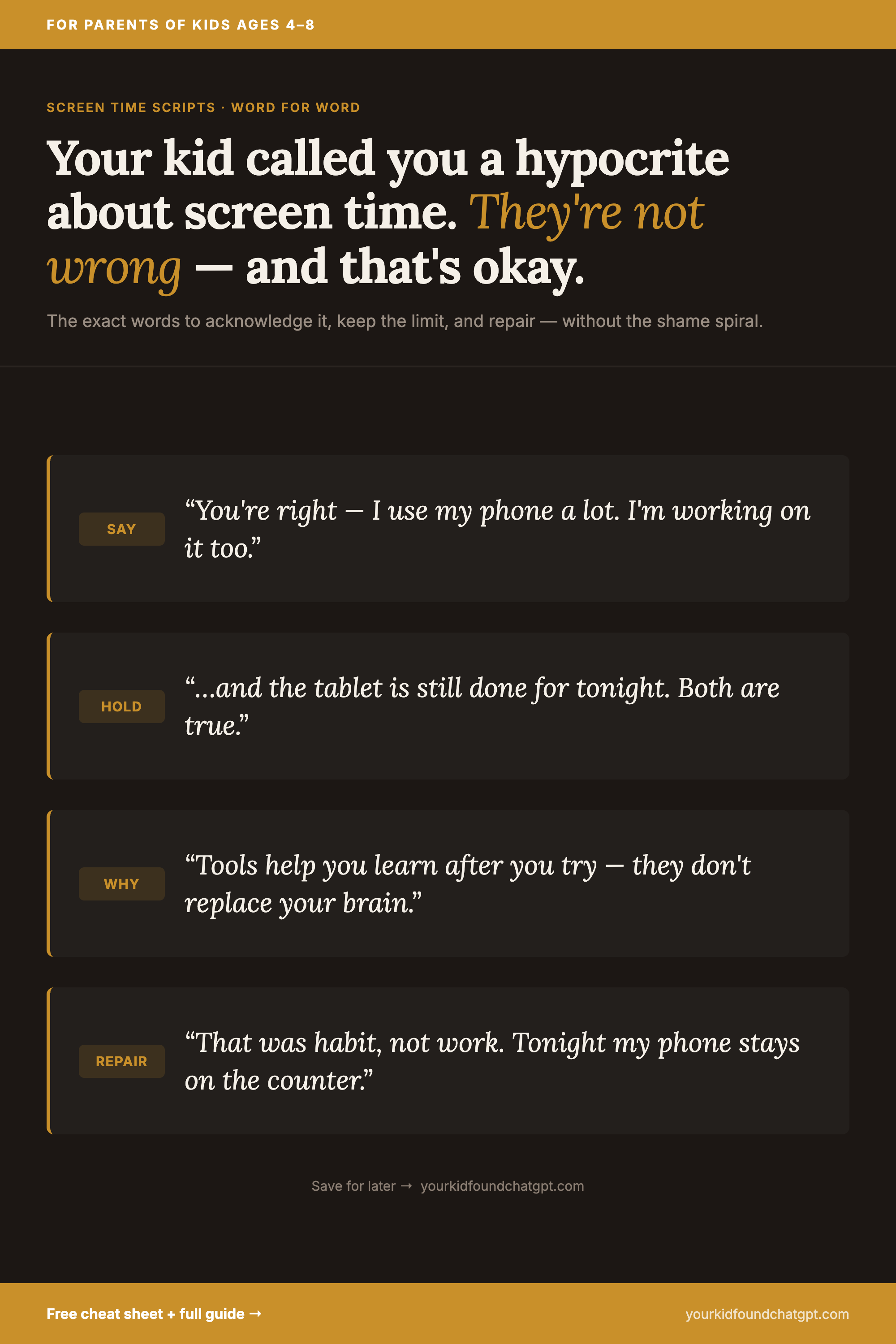
Save this graphic
Pin it to your "Parenting & Kids" board — the three scripts, condensed to one card you can find again at 7:40 p.m.
More parenting + AI content on Pinterest → Parenting in the Age of AI
Your kid isn't being defiant. She's being accurate.
Kids between 4 and 8 are the world's most precise hypocrisy detectors. They're watching you more carefully than you think — not to catch you out, but because you are their map of how adults navigate the world. When they see you pick up your phone at dinner and then hear "no screens at the table," the message they receive is not "screens are bad." The message is: rules are for people who aren't as important as Dad. Or: limits stop applying when you're older. Or simply: grownups say things they don't mean.
None of those are lessons you're trying to teach. And none of them require perfection to fix. What they require is acknowledgment — the willingness to say, out loud, "I use screens too, and here's how I think about it." That single sentence does more than any rule you could write, because it shows your child you're a real person navigating the same world they are, not a policy machine issuing commands from above.
The guilt is the symptom, not the problem
Parent guilt about screens has a stickiness to it. You feel guilty when your kid watches a show for an hour while you finish a work email. Then you feel guilty for feeling guilty, because you needed that hour, and you are also a person. And somewhere in the back of your head is the voice that says: a better parent would have handled this differently.
Here's what that voice gets wrong: it assumes there's a correct, obvious, pre-agreed answer you're failing to execute. There isn't. The pediatricians are still debating the guidelines. You are not behind a curve that exists — you're improvising in real time, like everyone else. The guilt isn't evidence that you're doing it wrong. It's evidence that you care.
But caring without a plan leaves you reactive — snapping, reversing your own rules, saying "fine, whatever." So here's the plan: three scripts, one for each version of the moment.
Script 1 — Acknowledge it without dropping the limit
Your child says: "But you're on your phone all the time." This is not defiance. It's accurate observation, and it deserves an accurate answer:
When the accusation lands mid-limit:
"You're right that I use my phone a lot. Some of it is work, some of it is habit I'm still figuring out. I have the same basic rule for myself: I try not to use it when it keeps me from being present with you. I'm not always great at it. Neither are you. We're both working on it."
That answer works because it is true. It treats your child like someone worth being honest with, and it doesn't pretend the rules don't apply to you — it models the thing you're actually trying to teach: everyone is learning to live with these tools, and noticing your own patterns is part of it.
Then — and this is the part parents miss — the tablet still goes off. Acknowledging the hypocrisy is not surrendering the limit. If she pushes, the follow-up is one sentence: "You're right about my phone. And the tablet is still done for tonight. Both of those things are true." A fair limit doesn't become unfair because the person holding it is imperfect.
Script 2 — The family "why," at kid height
Underneath the hypocrite accusation is usually a real question: why do we have these rules at all? That's not a complaint — it's a developmental question. Your child is building a map of how families work, and they've noticed that maps vary.
Your answer doesn't have to be a TED talk. It has to be honest, short, and repeatable:
Thirteen words a child can actually remember:
"In our family, tools help you learn after you try — they don't replace your brain."
And for your own phone, the honest version of "because I said so":
"I noticed I feel worse when I scroll a lot before bed, and I don't want that for you either."
A child can remember thirteen words. They cannot remember your seven-minute explanation of attention research. Pick your line, say it every time, and let boring consistency do the work. If your family's rules aren't written down anywhere yet, that's the real fix underneath this fight — a short set of written house rules gives your one-liner somewhere to live, and your kid something to point to besides your behavior.
Get the 1-Page Cheat Sheet for Your Fridge
The 5 house rules, the green/yellow/red homework system, and 5 word-for-word scripts — all on one printable page. Free.
No spam. One email with the cheat sheet PDF. That's it.
Script 3 — When you really were doomscrolling
Sometimes the accusation lands on a night when you can't claim it was work. You were forty minutes deep in a stranger's kitchen renovation while she asked you the same question three times. Don't spiral. Repair.
Repair is short. It doesn't require a formal apology ceremony or perfectly resolved feelings. It requires four moves: state the fact (not a character verdict), name the impact, say what happens next time, and reconnect.
When your child caught you breaking your own rule:
"Hey. You asked me to watch your card trick earlier and I kept saying 'one second' and kept scrolling. That wasn't work — that was habit, and it's one I'm trying to change. Tonight my phone stays on the kitchen counter until you're in bed. Want to show me the trick now?"
Under a minute, start to finish. The effect lasts far longer than the scrolling did. End on connection, not resolution — resolution can wait. Connection cannot.
This is the strongest modeling moment you get
You cannot lecture a six-year-old into healthy screen habits. But when you narrate your own — notice a pattern, name it out loud, adjust — your child watches an adult do the exact thing you're hoping they'll be able to do at nine, at thirteen, and with every AI tool that hasn't been invented yet. That skill transfers; screen time and AI aren't the same thing, but the habit of noticing how a tool makes you feel covers both.
So no, your kid calling you a hypocrite is not the wheels coming off. It's an opening. You can answer as the person who wrote the rules — or as the person living them alongside her. The second one is the parent she'll copy.
Frequently asked questions
What should I say when my kid calls me a hypocrite about screen time?
Acknowledge it honestly without dropping the limit. Try: "You're right that I use my phone a lot. Some of it is work, some of it is habit I'm still figuring out. I try not to use it when it keeps me from being present with you. I'm not always great at it. We're both working on it." Then hold the original limit — honesty and the limit are not in conflict.
Is it hypocritical to limit my child's screen time when I use my phone all day?
Not automatically. Adults and kids have different brains, different responsibilities, and legitimately different rules — much of adult phone use is work. But your child can't tell work from scrolling, so the difference has to be said out loud. What is hypocritical is pretending your own use doesn't exist. Acknowledge it, name your own rule for yourself, and the age-based difference becomes fair instead of arbitrary.
Should I drop screen time rules if I can't follow them myself?
No. Keep the limit and get honest about your own habits instead. Kids don't need a parent with perfect screen discipline; they need to watch an adult notice a pattern, name it, and adjust. A fair limit doesn't become unfair because the person holding it is imperfect — it becomes stronger when that person is honest.
How do I repair after my child catches me breaking my own screen rule?
Use a short four-part repair: state the fact without character judgment ("I said one second and kept scrolling"), name the impact, say what you'll do next time ("tonight my phone stays on the kitchen counter"), and reconnect — a hug, a joke, five minutes of whatever they wanted you for. It takes under a minute, and it models exactly the self-correction you want them to learn.
Your Kid Found ChatGPT. Now What?
Six conversation habits, word-for-word scripts — including the full hypocrite and repair playbooks — the green/yellow/red homework system, and a 7-day family onboarding plan. Written for parents of kids 4–8.
Get the guide — $19 →