Your 7-year-old comes downstairs during homework hour and announces: "ChatGPT says sharks can't get cancer." They say it the way they say the sky is blue — like it's a settled fact. Except it isn't. Sharks do get cancer. Researchers have documented it. The AI was confidently, completely wrong.
This is called a hallucination. It's not a glitch or a bug — it's a structural feature of how large language models work. And if your child is using ChatGPT, they will encounter one eventually. The question is whether they're equipped to notice it.
Why ChatGPT makes things up
ChatGPT isn't a search engine. It doesn't look things up. It generates responses based on patterns learned from enormous amounts of text — and sometimes those patterns lead it to produce a plausible-sounding statement that's simply false.
What makes this particularly tricky for children (and adults) is that the AI delivers wrong answers with exactly the same confident tone as correct ones. There's no "I'm not sure about this" flag. There's no hesitation. The false answer comes out polished, detailed, and authoritative.
Common categories where hallucinations appear most often: historical dates and details, scientific facts (especially recent research), quotes attributed to real people, book summaries, and anything requiring precise numbers.
What this actually looks like
Here's a real-world example of how this plays out at the homework table:
Both answers sound equally authoritative. The first is roughly accurate. The second is a common oversimplification that historians would contest (the Eastern Roman Empire continued for another thousand years, to 1453 AD). A child doing a report has no way to know which answer to trust.
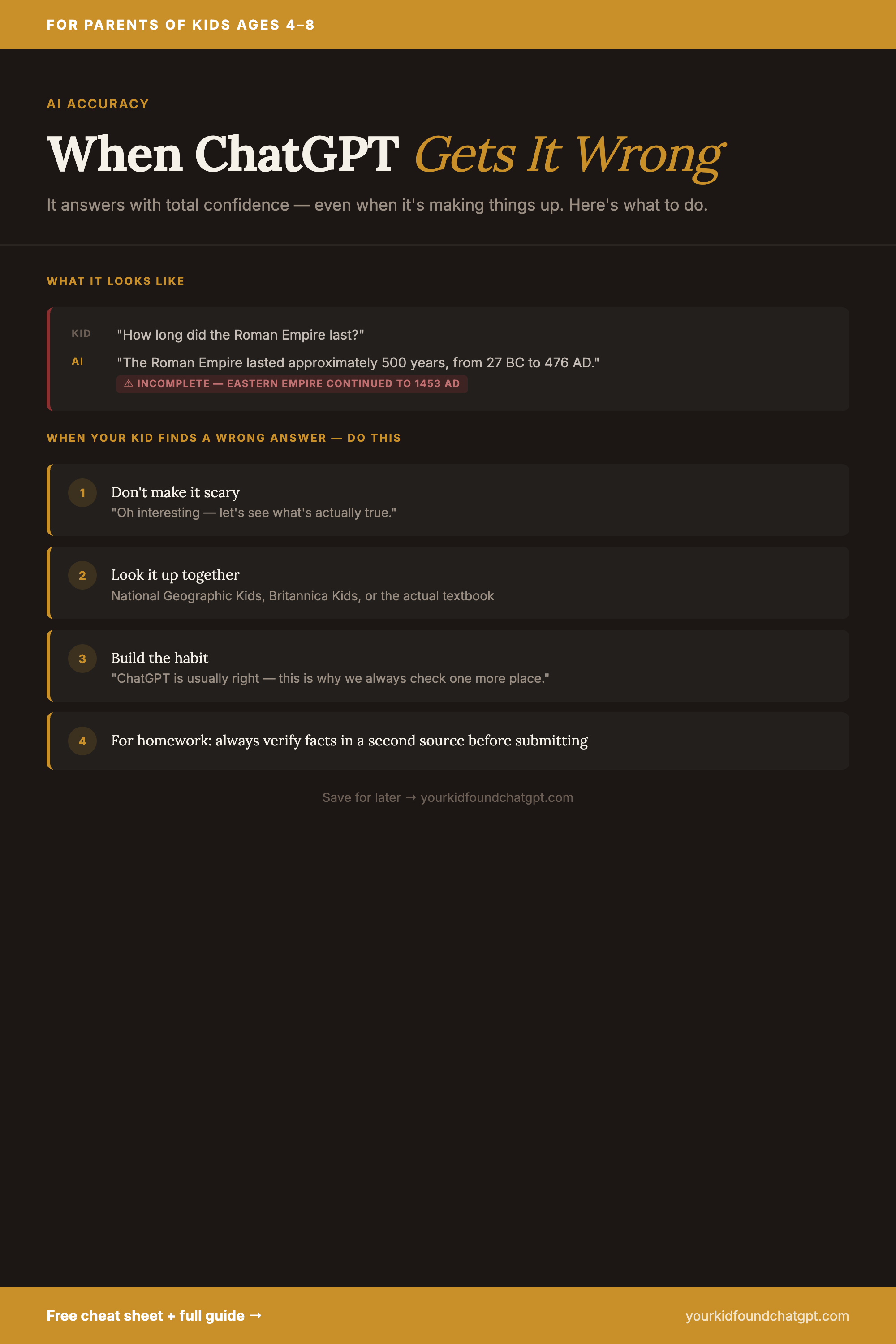
Save this graphic
Pin it to your "Parenting & Kids" board — a quick reminder of what to do when ChatGPT gets something wrong.
More parenting + AI content → Parenting in the Age of AI on Pinterest
Why kids are especially vulnerable
Adults have calibrated skepticism — years of experience with sources that confidently got things wrong. A child who's new to ChatGPT has no such calibration yet. To them, an AI that types quickly and uses complete sentences looks authoritative. The polished prose reads as confidence.
There's also a trust transfer problem. Kids already trust teachers, books, and parents. ChatGPT presents like all three: it explains patiently, it knows a lot, and it never seems confused. Without an explicit conversation about AI errors, a child has no reason to treat it differently from a textbook.
And young children, in particular, are still developing the metacognitive skill of wondering "how would I know if this is wrong?" That's a skill adults take for granted. For a 6-year-old, if something sounds reasonable and comes from a source that's usually helpful, it's probably true.
Get the 1-Page Cheat Sheet for Your Fridge
The house rules, the green/yellow/red homework system, and 5 word-for-word scripts — all on one printable page. Free.
No spam. One email with the cheat sheet PDF. That's it.
How to explain hallucinations to a child
The analogy that works best for kids ages 4–8 is the "very confident guesser." ChatGPT is like a friend who reads a lot of books, remembers most of what they read, but sometimes fills in gaps from memory without realizing they're guessing. They're not lying. They genuinely believe what they're saying. But sometimes they're wrong.
A script you can use verbatim:
"ChatGPT is really good at knowing things — but it's not perfect. Sometimes it gets facts wrong, and the tricky part is it doesn't know when it's wrong. So for anything important — a report, a science fact, a number — we always check it one more place before we trust it."
For older kids in this range (7–8), you can go one layer deeper: "ChatGPT isn't looking things up. It's predicting what the answer probably sounds like based on everything it's read. Usually that's right. But sometimes the prediction is wrong."
The one habit that protects against it
Verification. Specifically: a second source for anything factual before it goes in a school assignment.
This doesn't have to be complicated. For most homework-age fact-checking, it means:
- A quick search on a kid-appropriate site like National Geographic Kids, DK Findout, or Britannica Kids
- Asking a parent or teacher to read the key fact out loud ("does that sound right to you?")
- Checking the actual book the assignment came from, if there is one
The goal isn't a full research process. It's the habit of asking "how do I know this is right?" before closing the laptop. That single question, made routine before age 10, is one of the most durable things you can teach a kid about navigating information — with or without AI.
What to do when you catch a wrong answer together
Finding a ChatGPT error with your child is actually a gift, not a crisis. It's a concrete, vivid teaching moment. When it happens:
- Don't make it scary. "Oh interesting — ChatGPT got that one wrong. Let's see what's actually true."
- Look it up together. Walk through the verification process out loud so your child sees what it looks like.
- Say something neutral about AI. "This is why we always check. ChatGPT is usually right but sometimes it guesses wrong."
What you're doing is modeling the mental habit of holding AI answers loosely rather than accepting them as final. A child who's seen you do that a few times will start doing it independently.
The bigger picture
The hallucination problem isn't going away. It's a fundamental feature of how these models work, and while AI companies are working to reduce it, no current model is reliably error-free.
Your job isn't to scare your child away from a tool they'll use for the rest of their lives. It's to make sure they enter that relationship with a healthy calibration: trust but verify, use but don't outsource, lean on it but keep your own thinking engaged.
That calibration starts with one honest conversation: "ChatGPT is very good and sometimes wrong. Here's how we handle that in our family." For the full conversation framework — including what to say at each age from 4 to 8 — the AI house rules guide and the green/yellow/red homework system give you the structure to make it stick.
Your Kid Found ChatGPT. Now What?
Six conversation habits, word-for-word scripts, the complete green/yellow/red homework system, and a 7-day family AI onboarding plan. Written for parents of kids 4–8.
Get the guide — $19 →