It's 10:15. There's a glow under your 7-year-old's door. Lights out was at 9. You open it, the tablet goes face-down on the blanket, and a small voice says, "I was just..." If you caught your child on the tablet after bedtime tonight, you're standing in that hallway choosing between a speech and a scream, and later you'll type it into a search bar: caught my child on tablet after bedtime.
Short version: tonight gets two sentences. Tomorrow gets the conversation. Trying to do both at 10:15 is how the speech turns into the scream.
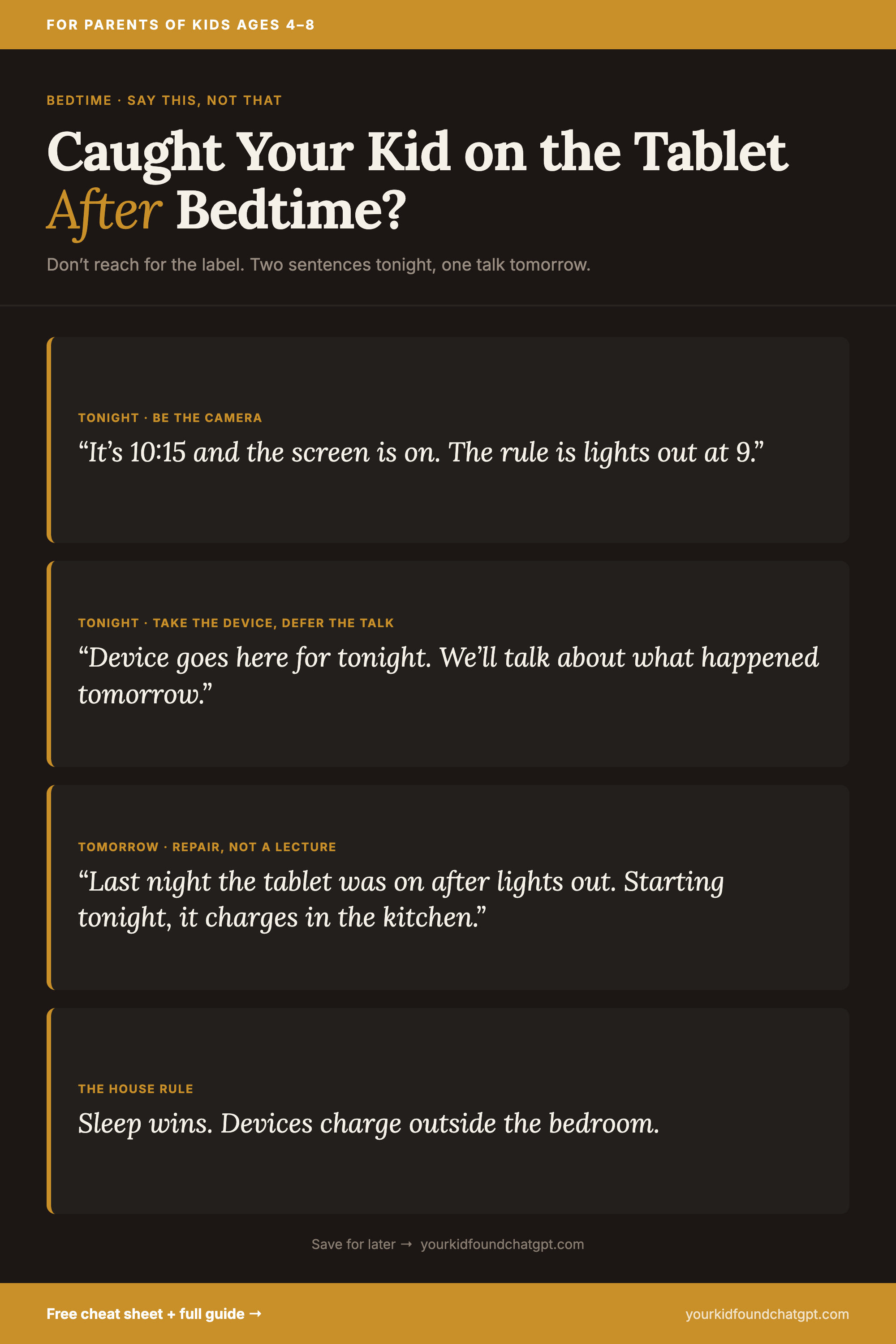
Save this graphic
Pin it to your "Parenting & Kids" board so the two sentences are there the next time there's a glow under the door.
More parenting + AI content on Pinterest → Parenting in the Age of AI
Why 10:15 is the worst time for the talk
Everything about the moment pushes you toward a label. You're tired and you feel lied to. The guide names it: when we are scared or tired, we reach for labels. Lazy. Addicted. Dishonest. Doesn't care. In a dark hallway, it's usually "I can't trust you with anything."
Labels name the wrong thing. They describe the child's character instead of the behavior, so your kid defends who they are instead of dealing with what they did. That's a standoff, not a conversation, and a tired 7-year-old who just got caught can't run one anyway.
So tonight's goal isn't justice or understanding. It's ending the night without a label, so tomorrow's talk starts clean.
Tonight: be the camera, then stop talking
The guide's second habit is built for this hallway: describe what you see. A camera describes; a judge evaluates. Say what an impartial observer would see, the clock and the screen, without editorializing. Then pause. Here's the bedtime version, word for word.
Two facts and a rule. Nothing about who your kid is.
"It's 10:15 and the screen is on. The rule is lights out at 9."
The guide's "before" version is "You're impossible. I cannot trust you with anything." That starts a fight about whether they're impossible, which can't be won. The camera sentence leaves nothing to defend.
Move an object. Name a time.
"Device goes here for tonight. We'll talk about what happened tomorrow."
The guide's stage direction is three words: quiet, not theatrical. No flourish. The talk is coming; it just isn't now, and saying so is what lets you leave the room.
"I was just..." gets a nod, not a cross-examination.
The silence is uncomfortable. Most parents fill it with more words or threats. Don't. Say goodnight. Turn off the light. Go.
That's it. Two sentences, one object moved, lights off. If it felt anticlimactic, it worked. It's the same describe-first move that gets the truth out when you find AI-written answers in homework.
Get the 1-Page Cheat Sheet for Your Fridge
The 5 house rules, the green/yellow/red homework system, and 5 word-for-word scripts, all on one printable page. Free.
Free cheat sheet now, plus a few short emails with scripts. Unsubscribe anytime.
Tomorrow: the two-minute talk
After breakfast, not in the car. Start the way the guide starts every discovery, with curiosity instead of a charge: "Tell me what happened last night, starting at the beginning." Then listen. Maybe they couldn't sleep, or a cousin messaged, or the game pings at ten. None of it changes the rule. All of it tells you what to fix.
Then the guide's repair shape: four beats, written so you never need the word "disappointed."
- Fact, not character. "Last night the tablet was on at 10:15, after lights out." Not: "You snuck it again."
- Impact. "That makes it harder for me to trust that bedtime is bedtime."
- Next time. "Starting tonight, the tablet charges in the kitchen. You carry it there after dinner." Specific, doable, forward.
- Reconnect. Toast, a bad joke, five minutes of whatever they like. The guide's rule: end on connection, not resolution. Resolution can wait. Connection cannot.
The guide's example is a homework one; these are the bedtime beats. They work in both directions, too. Some night you'll say "I can't trust you" and watch their face close. Next morning, the guide's script: "Hey. I got loud earlier in a way I didn't want to. I was frustrated and I didn't handle it well. That's on me, not you. Next time I'm going to take a breath before I respond. I'm working on it." Under a minute to say. Our article on repairing after you yelled about screens walks it through.
The rule that ends the repeat
The guide's fifth house norm is two words long: Sleep wins. In full: "Charging outside the bedroom is a simple rule that helps everyone, including you." The guide's point about why screens are hard to end: the ending isn't built in, so you are the ending, which is why you feel like the villain in your own house. A kitchen charger builds the ending into the house. No tablet in the room, no 10:15 decision for a 7-year-old to lose.
Two things make it stick. Write it down together, with a date; the guide notes a dated change prevents "but you said" fights. And tell everyone who does bedtime. The guide's caregiver one-pager has a blank for this: Bedtime and charging rule. Sitters can't enforce a rule they've never heard. The other four norms are in the five AI house rules.
If it happens again
Sometimes it isn't the first time, and "I was just..." came after a flat "no, I'm not." The guide's if/then table has a row for this: when lying about tool use shows up, pause the tool, repair, and tighten supervision without a shame spiral. In bedtime terms: a short, defined tablet break, the four beats, and the charger moves to where you'll see it. What you skip is the spiral, where a 7-year-old concludes they're a liar and acts like one.
If it keeps happening, look under it. The guide says some screen fights are about something else: this is where I feel capable, this is where nobody tells me I'm doing it wrong. A kid awake at ten may be a kid who can't settle, and the tablet is what settles them. One acknowledgment, no therapy voice: "Hard to fall asleep lately, huh?" Then back to the rule. It's the same move that keeps a 7 p.m. screen "no" from becoming a meltdown.
What you're actually teaching
The tablet after bedtime is a small crime. The lesson is what happens when you get caught in this house: someone says what's true, puts the thing away, and talks to you in the morning like a person. You want a 7-year-old to expect that, because at 14 the thing under the blanket will be bigger, and whether they tell you will be the whole game.
So tonight: the fact, the device, the door. Tomorrow: the four beats and the kitchen charger. Then sleep. It wins.
Frequently asked questions
What should I say when I catch my kid on the tablet after bedtime?
Keep it to two quiet sentences. "It's 10:15 and the screen is on. The rule is lights out at 9." Then: "Device goes here for tonight. We'll talk about what happened tomorrow." Take the tablet, say goodnight, and leave. Do not debate, lecture, or label at 10:15. A tired child who just got caught cannot take in your reasoning, and a late-night fight teaches nothing except how to hide the screen better. Save the conversation for the morning.
Should I punish my child for using the tablet after bedtime?
Lead with repair, not punishment. The next morning, ask what happened, then use four beats: the fact (the tablet was on after lights out), the impact (it is harder to trust that bedtime is bedtime), next time (the tablet charges in the kitchen starting tonight), and a reconnect. If it is a repeat or came with a lie, the tablet can take a short, defined break and supervision tightens, but skip the shame spiral. A child who decides they are a liar tends to act like one.
How do I stop my kid from sneaking the tablet at night?
Charge devices outside the bedroom. It is the simplest rule in the house, and it removes the 10:15 decision entirely because there is nothing under the blanket to decide about. Pick a charging spot you walk past, have your child carry the tablet there after dinner, and write the rule down together with a date. Tell grandparents and babysitters the same rule so bedtime does not depend on who is on duty.
Is a 6-year-old old enough for a charging-outside-the-bedroom rule?
Yes, and younger. A 6-year-old can carry a tablet to the kitchen as part of the after-dinner routine, and kids are more likely to own a rule they helped write down. Keep the reason short and in kid vocabulary, something like "Sleep wins. Screens charge in the kitchen so your brain can switch off." Then make the routine the same every night, so the rule belongs to the house instead of being a fresh argument with you.
Your Kid Found ChatGPT. Now What?
Six conversation habits with word-for-word scripts labeled by age, the green/yellow/red homework system, the moments that blindside you (the first device, after bedtime, the homework that wrote itself), and 16 printable worksheets. A 121-page PDF for parents of kids ages 4 to 12.
Get the guide, $19 →