It's 8:40 on a Tuesday. The tablet was supposed to be off at 8:00. You asked once, then twice, and the third time something in you snapped — you pulled it out of your kid's hands and heard your own voice come out louder and harsher than you ever meant it to. Now they're crying in their room, the tablet is sitting on the counter like evidence, and you're standing in the kitchen replaying the whole thing.
If you're searching for how to repair after yelling at your kid about screens, here is the honest starting point: the yelling is not the part of tonight that decides how this goes. The next ten minutes are.
Yelling doesn't mean the system failed
You will snap. Your child will melt down over a screen limit. You will say something you regret. These are not failures of your screen-time plan — they are the plan working normally, because the plan involves parenting a human being while being one yourself.
What separates parents who build trust over time from parents who accumulate resentment is not the absence of bad moments. It's the presence of repair. And repair is much smaller than most parents think: it does not require a long conversation, a formal apology ceremony, or perfectly resolved feelings. It takes about two minutes, and it has four parts.
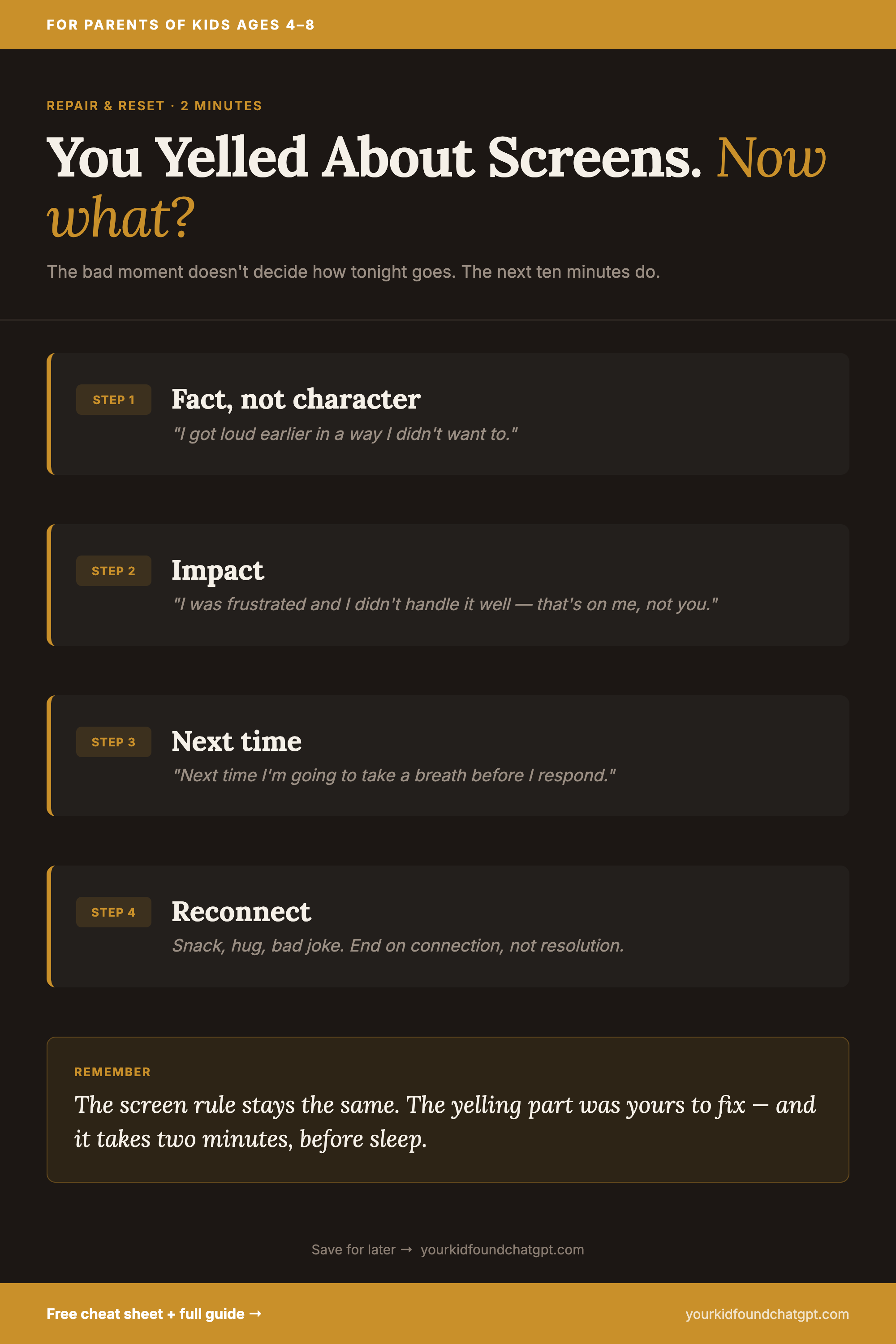
Save this graphic
Pin the 4-step repair to your parenting board — for the next time a screen fight goes sideways at 8:40 p.m.
More parenting + AI content on Pinterest → Parenting in the Age of AI
The 2-minute repair, step by step
The shape below works for any rough moment, but it's written here for the one you're in tonight: you lost your temper over screens, and your kid is somewhere in the house feeling small.
Name what happened as a plain fact, with no verdict on anyone's character.
"I got loud earlier in a way I didn't want to" is a fact. "You made me yell" is not — it hands your kid the blame for your volume. Keep the fact about your own behavior and keep it to one sentence.
"I got loud earlier in a way I didn't want to."
Say what was going on for you, briefly and honestly.
One sentence of honesty does more than a paragraph of explanation. You're modeling something rare: an adult who can name a feeling without being ruled by it.
"I was frustrated and I didn't handle it well — that's on me, not you."
Say what you'll do differently. Specific, doable, forward.
Not a vow to never yell again — a small concrete move you can actually make. A breath before responding. Setting a timer so the warning isn't a surprise. Kids trust specific far more than they trust perfect.
"Next time I'm going to take a breath before I respond. I'm working on it."
End on connection, not resolution.
A snack, water, a hug, five minutes of drawing, a bad joke — whatever fits your kid. You are not trying to resolve the screen-time question tonight. Resolution can wait. Connection cannot.
"Want to split the last of the crackers before bed?"
Put together, the core of it is twenty-nine words:
"Hey. I got loud earlier in a way I didn't want to. I was frustrated and I didn't handle it well — that's on me, not you. Next time I'm going to take a breath before I respond. I'm working on it."
Forty-five seconds to say. The effect lasts much longer than that.
Get the 1-Page Cheat Sheet for Your Fridge
The 5 house rules, the green/yellow/red homework system, and 5 word-for-word scripts — all on one printable page. Free.
No spam. One email with the cheat sheet PDF. That's it.
What repair is not
Repair is not reversing the limit. If the tablet was supposed to be off at 8:00, it was still supposed to be off at 8:00. You're apologizing for the delivery, not the decision — and saying so out loud keeps the two from blurring: "The screen rule stays the same. The yelling part was mine to fix."
Repair is also not a shame spiral in the other direction. If you apologize five times and ask your kid to comfort you, the repair has quietly become their job. One clean pass through the four steps, then done. If the guilt is still loud in your head afterward, that's yours to carry to another adult, not back to your child.
If they broke the rule and you yelled
Most screen blowups are a package deal: they kept playing after the limit, and you lost it. Handle the two halves separately. Your yelling gets the repair above, first. Their rule break gets the same four-step shape — fact, impact, next time — in a calm voice, without the character verdict: "The tablet stayed on past the limit" rather than "you never listen."
If the same fight keeps happening, treat that as a structure problem rather than a character problem. Cut back what's hardest to supervise instead of half-enforcing everything, and make the limit visible — a timer your kid can see beats a warning they can claim they never heard. If the meltdowns cluster in the minutes right after screens go off, that dip is real and has its own playbook: see the post-screen slump. And if your kid answers the rule with "well, you're always on your phone" — that one deserves its own script too: when your kid calls you a hypocrite about screen time.
Tonight, before sleep
The best window for repair is the one that closes soonest: before your child falls asleep tonight. Sit on the edge of the bed, do the four steps, land on connection. Two minutes.
There will be a night when you say exactly the wrong thing and end up back in the kitchen feeling like none of this worked. That's not you failing at parenting. That's Tuesday. The question was never whether the bad moment happens — it's whether a two-minute repair follows it. Families that repair don't have fewer hard nights; they just stop paying interest on them. If you want the rest of the framework the repair comes from — the house rules, the homework zones, all six conversation habits — it's one printable guide away.
Frequently asked questions
How do I repair with my child after yelling about screen time?
Keep it to four steps and about two minutes: name the fact without character judgment ("I got loud in a way I didn't want to"), name the impact, say what you'll do differently next time, then reconnect — a snack, a hug, a bad joke. End on connection, not resolution. Resolution can wait; connection cannot.
Does apologizing to my kid for yelling undermine my authority?
No — apologizing for how you said it is not the same as reversing what you said. The screen limit stands. You're repairing the delivery, not the decision. A kid who watches a parent own a misstep learns that mistakes are fixable, which is exactly the lesson you want them applying to their own rule breaks.
How soon after yelling should I repair?
Same day if at all possible, and before your child goes to sleep is the best window there is. The repair itself takes about two minutes, so you don't need to wait until you've found the perfect words. Short beats perfect, and starting beats waiting.
What if my kid broke a screen rule and I also yelled?
Repair your part first, separately from enforcing theirs. Own the yelling in one or two sentences, reconnect, and let the consequence for the rule break stand on its own. If rule breaks keep turning into shouting matches, tighten the structure — fewer screens to police, clearer time limits — instead of half-enforcing everything.
Your Kid Found ChatGPT. Now What?
Six conversation habits — including the full repair-and-reset habit this article comes from — word-for-word scripts, the green/yellow/red homework system, and a 7-day family onboarding plan. Written for parents of kids 4–8.
Get the guide — $19 →