The show ends. The tablet goes dark. Your kid slides off the couch, drifts around the living room for about ninety seconds, and then it comes — flat, aggrieved, like the floor just fell out: "I'm booooored. There's nothing to do."
You gesture at the bin of toys, the whole rest of the house. It doesn't land. Within minutes you're in a standoff over a child who, ten minutes ago, was perfectly content — and the easiest exit is the one you don't want: just turn something back on.
If your kid is bored right after screen time and it keeps curdling into a meltdown, you're not doing anything wrong, and neither are they. This is a predictable little dip — call it the post-screen slump — and once you know what it is, you stop fighting it and start walking your child through it.
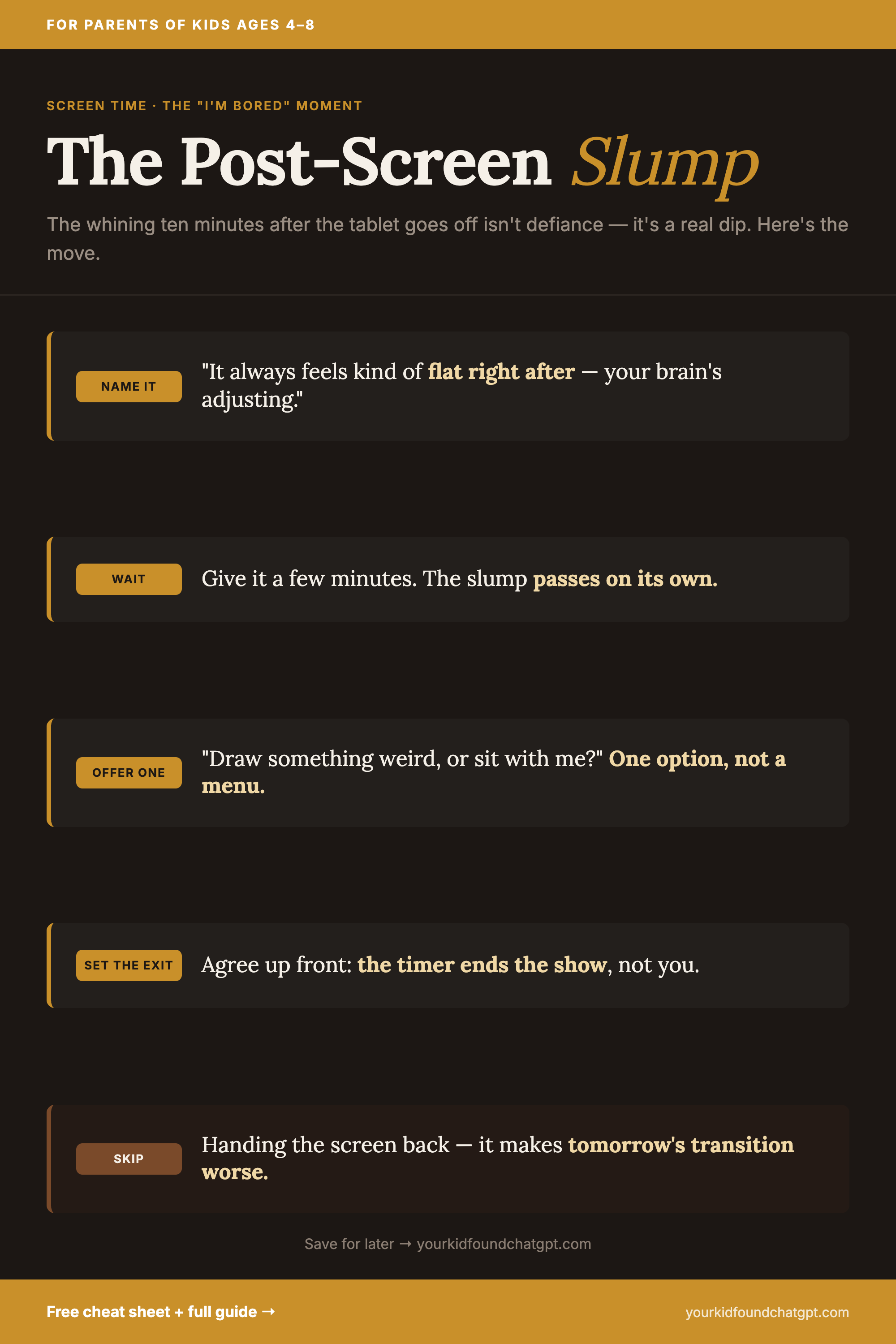
Save this graphic
Pin the post-screen slump scripts to your "Parenting & Kids" board so the words are one tap away the next time the tablet goes off.
More parenting + AI content on Pinterest → Parenting in the Age of AI
What "I'm bored" actually means right after a screen
When your child says they're bored a few minutes after a device gets taken away, they are telling you something true about their nervous system: it has been running at high stimulation, and the sudden drop to ordinary is uncomfortable. A show or a game delivers a constant stream of color, motion, reward, and novelty. Real life — the living room, the toy bin, you asking them to put shoes on — moves a lot slower. For a little while, slower reads as empty.
That is the whole slump in one sentence: not a discipline problem, not manipulation, just a brain re-adjusting its baseline. The most useful thing to know about it is the last part — it passes. The flat feeling is real and it is temporary, usually gone in a few minutes if nobody panics and refills the tank.
This is also why "go find something to do — you have a thousand toys" reliably backfires. It's true and completely useless: in the slump your child isn't short on options, they're short on the capacity to feel interested in any of them yet. You're handing a map to someone who's seasick.
Feel it first, limit second
There's a default sequence most of these moments follow: child complains, parent offers a fix or a fact, child rejects it, parent's voice climbs, everyone loses. The problem is the order, not the words. When a young child is in the grip of a feeling, the logical part of the brain isn't fully available for your reasonable suggestion. They're not ignoring your idea because they're spoiled. The want — or in this case the flat, itchy discomfort — is just too loud to think over.
What cuts through it isn't a better suggestion delivered louder. It's acknowledgment: a brief, honest recognition that the feeling is real, before you steer anywhere. This is Habit 1 from our guide — acknowledge the pull — and it's the single move that turns the post-screen slump from a fight into a two-minute dip.
Say it lightly, like a weather report, not a lesson:
"Yeah, it always feels kind of flat right after. Your brain's adjusting — give it a few minutes."
That's roughly fifteen words, and it's doing more than it looks. It tells your child the feeling is normal, it's temporary, and it has a cause that isn't "something is wrong." You're not agreeing to turn the screen back on. You're proving you heard them — and a young nervous system knows the difference between being managed and being understood.
Then, and only then, offer a way out. One option, maybe two — never a menu, which just becomes a new thing to reject:
"Want to draw something weird, or come sit with me while I finish this?"
Most kids, once the feeling has been named, will take one of the two. Not because the drawing is thrilling, but because the pressure valve already released when you acknowledged the landing. The alternative is just something for their hands to do while the slump lifts on its own.
Get the 1-Page Cheat Sheet for Your Fridge
The 5 house rules, the green/yellow/red homework system, and 5 word-for-word scripts — all on one printable page. Free.
No spam. One email with the cheat sheet PDF. That's it.
Build the ending before the slump starts
The slump shrinks when the screen doesn't end abruptly on you. Screens and AI tools quietly remove the natural stopping points that used to end play — there's always a next episode, a new level, one more question to ask. The ending isn't built in, so you become the ending. That's why you so often feel like the villain in your own living room: you're the one who walked over and made the fun stop.
The fix is to hand the stopping job to something outside you. "When this episode ends" or "when the timer goes off" turns you from the person taking something away into the person enforcing a rule you both agreed to in advance. Set it before you press play, not in the heat of the ask.
Built on the guide's transition principle — agree on the ending before the screen goes on:
"One show, and when the timer beeps the tablet goes to sleep. The timer's the boss on this one, not me. Deal?"
Predictable, announced in advance, with a clear external signal — that combination does more to prevent the meltdown than any script you deploy after it's already underway. It's the same logic behind keeping devices out of the bedroom at night; if you want the deeper version, our 5 AI house rules for families lays out the "sleep wins" rule and four others worth writing down together.
What not to do in the slump
- Don't hand the screen back to stop the whining. It works for four minutes and teaches your child that the flat feeling is an emergency more stimulation will solve — which makes tomorrow's transition worse. Riding it out a few times is what actually shrinks it.
- Don't fake the empathy. "Oh, you're sooo bored, that's sooo hard" — kids detect sarcasm by age four, and it lands as contempt. Mean the acknowledgment or skip it.
- Don't acknowledge and then re-launch the lecture. Name the feeling once, offer the alternative, and stop talking. Acknowledgment is a pause before the limit, not the opening of a negotiation.
When the slump is really about something else
Sometimes the boredom after a screen isn't only about stimulation. For a kid who struggles at school, a game they're good at is a refuge; for one who feels overshadowed by siblings, a device that answers only to them is a kind of recognition. Losing that can sting more than losing "the fun." You don't need a therapy voice — just, now and then, address the feeling under the request instead of only the screen. A child who hears "you really liked being good at that" feels seen, and a seen kid argues less.
This is the same muscle you use when a screen-time limit turns personal — like when your kid fires back that you're on your phone too. And if you're still sorting out how screens and AI tools even fit into your family's rules, our take on whether screen time and AI are the same thing is a good next read.
The post-screen slump never fully disappears — it's baked into how a small nervous system works. But it goes from a nightly standoff to a two-minute dip once you stop treating the boredom as bad behavior and start treating it as a landing your kid just needs a little help sticking.
Frequently asked questions
Why is my kid so bored right after screen time?
Because the screen kept your child's nervous system running at high stimulation, and when it switches off, the drop to ordinary feels flat and uncomfortable. That empty feeling is real, not manipulation, and it isn't a sign the screen was taken away too soon. For most kids ages 4-8 it's the brain readjusting to a slower pace, and it passes within a few minutes if you don't rush to fill it.
What should I say when my child says "I'm bored" after screens?
Name the landing before you try to fix anything: "Yeah, it always feels kind of flat right after. Your brain's adjusting - give it a few minutes." Then offer one specific alternative, not a list - "Want to draw something weird, or come sit with me while I finish this?" Acknowledging the feeling first is what lets a young child actually hear the rest.
How long does the post-screen slump last?
Usually just a few minutes - often under ten - as your child's brain resettles to an ordinary pace. The fastest way to make it last longer is to hand back a screen, because that teaches the brain the slump is an emergency that more stimulation will solve. Ride it out calmly a handful of times and the slump tends to get shorter on its own.
Should I give more screen time to stop the boredom?
It's tempting, but handing the device back to end the whining trains your child to expect another hit of stimulation every time the flat feeling shows up, which makes the next transition harder. A better move is a predictable ending you set in advance - when this show ends, or a timer - so the screen stops on an agreed signal instead of on you, and boredom becomes something your child learns to move through.
Your Kid Found ChatGPT. Now What?
All six conversation habits — including the full "acknowledge the pull" method, the green/yellow/red homework system, repair scripts, and a 7-day family onboarding plan. Written for parents of kids 4–8, for exactly the flat-tablet moments like this one.
Get the guide — $19 →