It's 7:40 on a school night. Your 6-year-old asked for one more show, and you said no, it's almost bedtime. Two minutes later the TV is back on. "Dad said I could." Now two adults are standing in the living room with the remote between them, and a small person on the couch is watching to see who wins. Later, after the kids are asleep, you type it into a search bar: my husband and I disagree about screen time.
Short version: you don't have to settle screen time tonight, and you shouldn't try to in front of your kid. The guide gives you one sentence for the living room and saves the real disagreement for after bedtime. Below: the sentence, who answers the next "can I?", and what to talk about once the house is quiet.
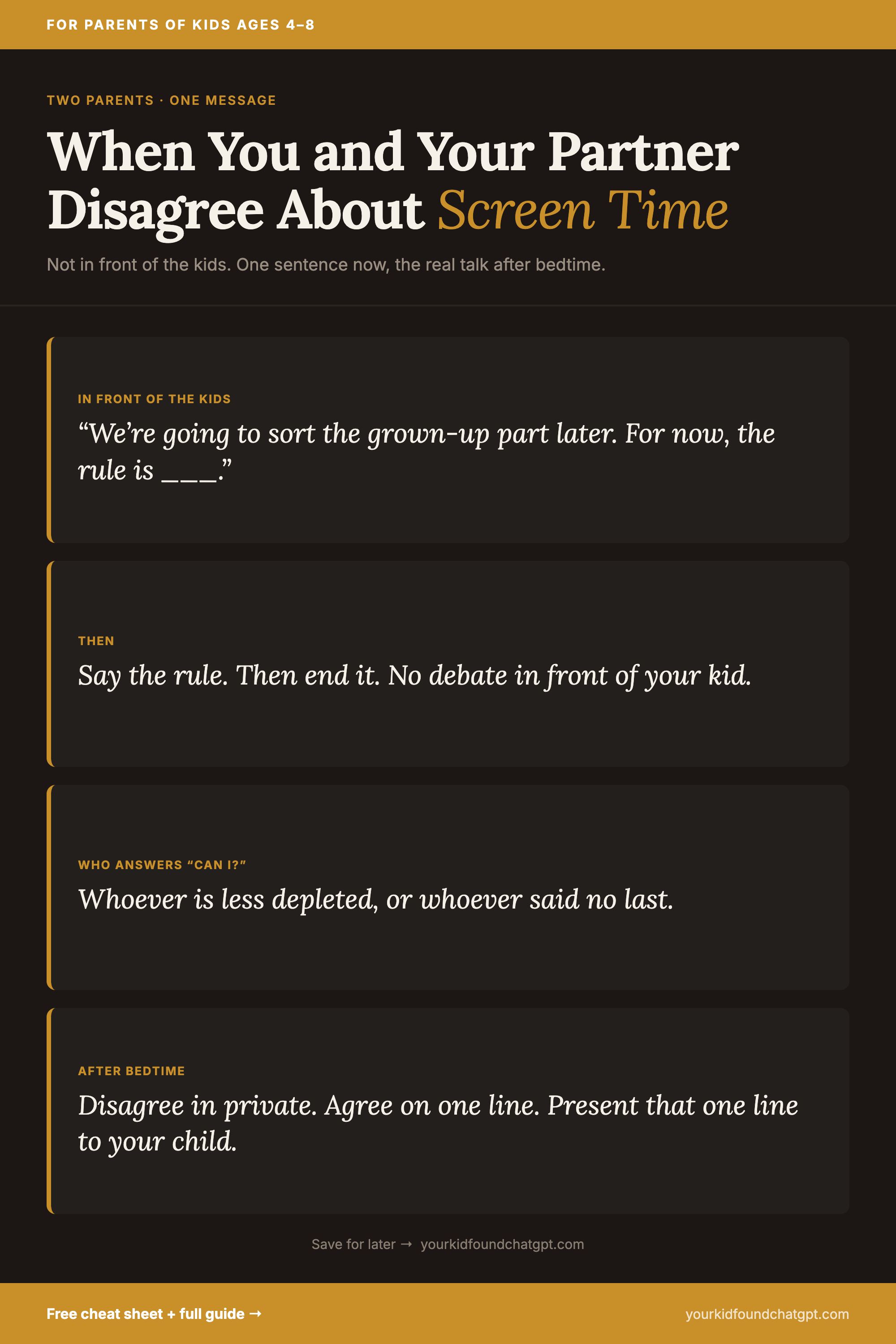
Save this graphic
Pin it to your "Parenting & Kids" board, or send it to your partner tonight. It's easier to agree on a line before the next 7:40 than during it.
More parenting + AI content on Pinterest → Parenting in the Age of AI
Your kid isn't playing you. They found the gap.
It's tempting to hear "Dad said I could" as a con. The guide reads it differently: "Kids are remarkably good at finding the gap between two parents and living in it. This is not manipulation. It's adaptation."
A 6-year-old who wants a show asks the adult most likely to say yes. That isn't scheming. If the two of you give different answers, they'll keep asking whoever said yes last time.
The guide is also honest about the fix: "The fix is not agreeing on everything. You will not agree on everything." You need one answer your kid hears, and somewhere to disagree that isn't the living room.
The line to say in front of the kids
Here's the sentence, word for word from the guide's partner-alignment section:
One sentence. Either parent can say it.
"We're going to sort the grown-up part later. For now, the rule is ___."
The guide's instruction after it is short: "Then say the rule. Then end it." In practice that's three moves.
1. Say the sentence. It tells your kid the adults will settle this, and that they are not the referee.
2. Fill in the blank. For tonight, use the answer your kid heard first. If one of you already said no, the no stands. That isn't the "no" parent winning. It's the house not changing its answer mid-evening. If that first answer was wrong, fix it in the after-bedtime talk.
3. End it. No second round of reasons. The show goes off and you move on to teeth and pajamas. If your kid pushes back, that's an ordinary limit moment, and the name-the-limit, offer-a-real-choice script works here too: "Do you want to press stop yourself, or want me to press it with you?"
If you have a breath first, spend it on the guide's first habit: "Feel it first. Limit second." "You really wanted that show" takes three seconds.
Get the 1-Page Cheat Sheet for Your Fridge
The 5 house rules, the green/yellow/red homework system, and 5 word-for-word scripts, all on one printable page. Free.
Free cheat sheet now, plus a few short emails with scripts. Unsubscribe anytime.
Decide who answers "can I?"
Most of these collisions start the same way: a kid asks one parent, doesn't like the answer, and goes to find the other. The guide's fix is a default parent for "can I?" questions in the moment, picked like this: "whoever is less depleted, or whoever said no last."
Less depleted means the one with enough patience left to hold a no without snapping. Whoever said no last closes the loop: if Mom already answered, the question goes back to Mom. That gives the second parent a one-line job when the kid walks in asking: "What did Mom say?"
Have the real conversation after bedtime
The guide is specific about where the actual disagreement belongs: "A private conversation after the kids are in bed to actually talk through the disagreement, without your child there to mediate." Its if/then table fits the whole move into one row: "Disagree in private, present one line."
One line is the useful part. You aren't deciding whether screens are good or bad. You're deciding what happens at 7:40 on a Tuesday. The guide's partner-alignment page (Reference H) gives you the questions, with a column for each parent:
- Default yes window for recreational screens
- Homework point person, Monday to Thursday
- Default parent for "can I?"
- When we disagree in the moment: "Pause + ___"
- First answer stands: agreed?
- How we repair after a rule break
Fill in your columns separately, then compare. Where they match, you're done. Where they don't, the page has a spot for that too: "Topics to sort privately." Not every gap has to close the same night.
Notice what the page never asks: who is right about screen time. If one of you wants zero weekday shows and the other wants one after homework, you can still agree on who answers "can I?" and what gets said in the living room.
Put it on one page and both sign it
A deal made at 10 p.m. is easy to lose by Thursday. The guide's answer: "One written page of norms (Reference C) that both adults have actually read and signed." It's the five house norms plus a sixth row for a rule of your own, with blanks for your exact rule and who enforces it, a date you agreed and a date to review, and signature lines for two adults and, if you like, your kid. If you haven't written house rules yet, start with the five defaults.
The date matters more than it looks. As the guide says about updating the norms, "Dating the change prevents 'but you said' fights." That works between adults, too.
Grandparents or a sitter get a shorter one-pager (Reference I) with the homework rule, screen windows, and who to call. As the guide puts it, "They don't need the philosophy. They need the operating instructions."
If it already turned into an argument in front of them
Sometimes the sentence comes too late and the living room gets loud. "Repair works in both directions," the guide says, and its script for your own misstep fits this night almost as written:
"Hey. I got loud earlier in a way I didn't want to. I was frustrated and I didn't handle it well. That's on me, not you. Next time I'm going to take a breath before I respond. I'm working on it."
Either of you can say it before bedtime. "That's on me, not you" carries the weight, because a kid who watched two parents argue about their show may quietly decide it was their fault. Then add the short news: you two are sorting it out, and there will be one answer. The full four-step version is in how to repair after yelling about screens.
What your kid actually learns
Two parents who see screens differently aren't the problem for a 6-year-old. Two parents arguing the rule out with that 6-year-old as audience, judge, and prize are. The sentence, the default parent, and the after-bedtime talk all do one job. They take your kid out of the middle and put them back where they belong: on the couch, a little annoyed that the show is off.
So tonight: one sentence in the living room, and one question once the kids are asleep. "Who answers 'can I?' when we're both home?" Start there.
Frequently asked questions
What should we do when my husband and I disagree about screen time?
Don't try to settle it in front of your kid. Disagree in private, agree on one operational line, and present that line to your child. You don't need to agree on whether screens are good or bad. You need to agree on what happens in the moment: who answers "can I?" questions when you're both home, and what you'll say if you disagree out loud. Write it on one page and both sign it.
What do I say when my partner says yes after I already said no?
Use one sentence and keep it short: "We're going to sort the grown-up part later. For now, the rule is ___." Fill in the blank with the answer your child already heard, say the rule, and end it. No debate in front of your kid. Then talk it through with your partner after the kids are in bed, and if the first answer was wrong, change it for next time.
Is it bad to disagree about screen time in front of the kids?
Kids will notice that their parents see things differently, and that is normal. The problem is arguing the rule out with your child watching, because it puts them in the middle and teaches them to ask whichever parent is likelier to say yes. Pause, give one answer, and move the real conversation to after bedtime. If it already got heated, a short repair before your child goes to sleep helps.
How do we get on the same page about screen time?
Sit down after the kids are asleep and answer the same few questions separately: when recreational screens are allowed, who handles homework on weeknights, who answers "can I?" when you're both home, and what you'll do if you disagree in the moment. Compare answers. Agree on what matches, and write down what doesn't as something to keep working on. Put the result on one page, date it, and both sign it.
Your Kid Found ChatGPT. Now What?
Six conversation habits with word-for-word scripts labeled by age, the green/yellow/red homework system, the moments that blindside you (the first device, after bedtime, the homework that wrote itself), and 16 printable worksheets. A 121-page PDF for parents of kids ages 4 to 12.
Get the guide, $19 →