It's the second week of December. The box is behind the wrapping paper on your closet shelf, and your 10-year-old has asked since summer: "Can I PLEASE get a phone? Maya got one and she's younger than me." You've said yes. Now you're searching first phone contract for kids, because the ten minutes after the paper comes off matter.
Short version: write the deal before the device turns on, and make it a license, not a present. Here are the five terms, the word-for-word scripts from our guide's first-device chapter, and a free one-page agreement.
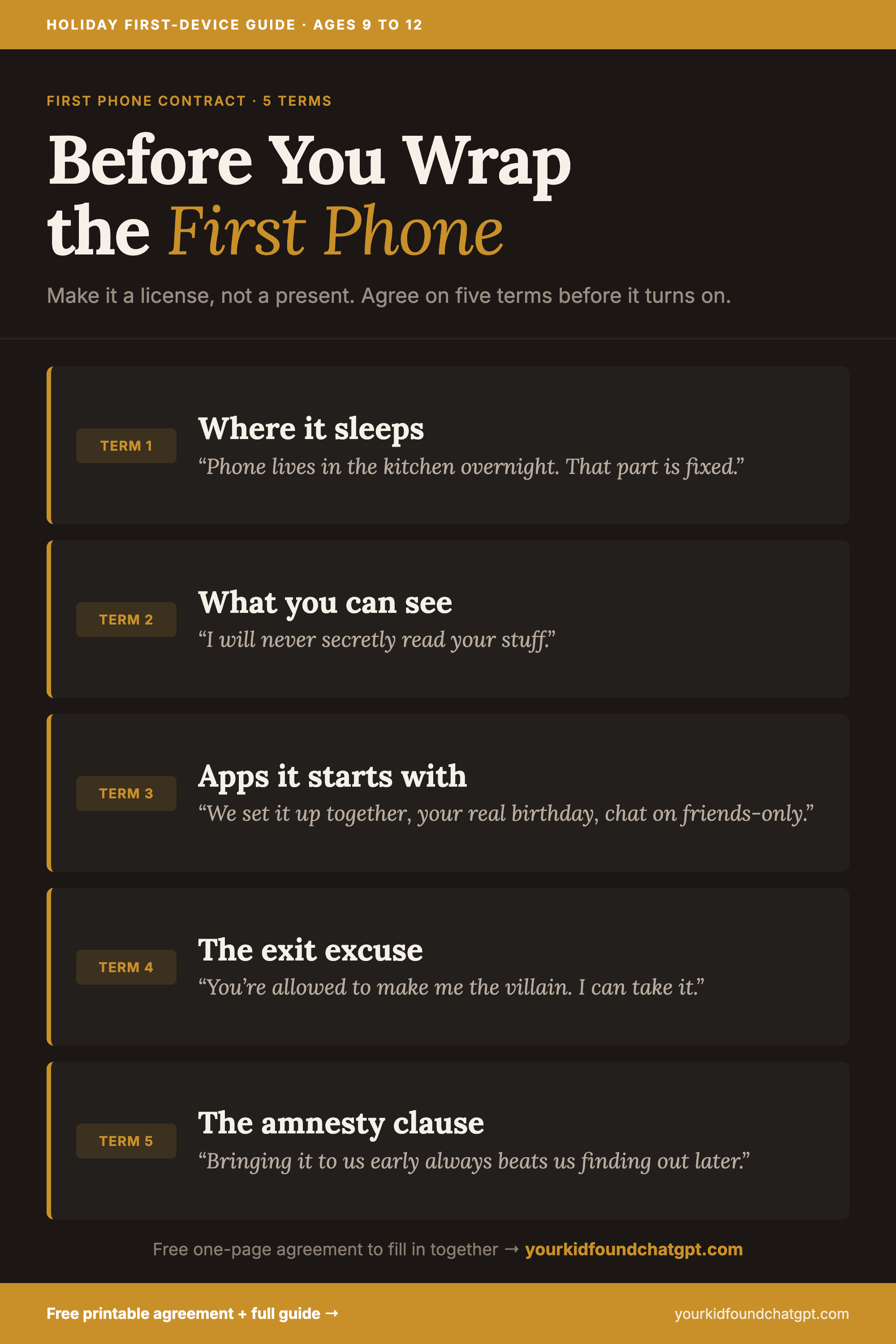
Save this graphic
Pin it to your "Parenting & Kids" board so the five terms are on hand the night you wrap the box.
More parenting + AI content on Pinterest → Parenting in the Age of AI
A license that happens to arrive on a holiday
To your kid, the guide says, a phone is citizenship: existing where their social world now lives. To you, it is mostly irreversible. A tree makes that harder, because everything under it says this is yours now. So borrow the guide's frame: a driver's license, not a birthday present. It can still arrive Christmas morning. It just arrives with terms, set by the first thing you say:
"Here's the part I need you to know before day one: the phone belongs to the family and you're the main user. That's not a trick, it's the deal. The deal gets bigger every time you show me it's working."
Three questions before you wrap it
The guide runs this decision on readiness and need, not age, and climbs a ladder: a watch, a call-and-text phone, a shared device, a phone without a browser or social apps. As three questions:
- Readiness. Has the tablet routine run without you chasing it? The guide's line: "Show me three months of handling the tablet rules without me chasing you, and we start with step one."
- Need. What is it for? If the answer is reaching each other about plans, the lowest rung that does that job is the right present.
- Terms. Can you say the deal out loud before it turns on? If not yet, you're not ready to wrap it.
A no isn't a no to the holiday. It's a lower rung, wrapped, with the next rung's date written in the card, because a ladder with no dates reads as never.
The five terms, word for word
All five come from the guide's first-device agreement for ages 9 to 12, which you fill in together, out loud, before the device turns on.
You fix the overnight spot. Your kid picks the dock time inside your window.
"Phone lives in the kitchen overnight. That part is fixed. You pick the docking time, anywhere from 8:30 to 9:30, and we run your pick for two weeks before we revisit."
The guide's note: the kid picks 9:00 and then defends 9:00, because it's theirs. It's the same kitchen charger from what to say when you catch them on the tablet after bedtime.
The boring dashboard stays visible: apps, screen time, contacts. Messages are not read by default.
"I will never secretly read your stuff. If I ever need to look, it's with you sitting next to me, and I'll say why first. In exchange, when I ask who someone is, I get a real answer."
Nothing covert, ever: spot-checks are announced, with your kid present, never an ambush.
A short list, written down. New ones get set up together.
"New game, same two minutes: we set it up together, your real birthday, chat on friends-only. That's the toll booth. After that I'm out of your way."
The real birthday makes the platform's age defaults engage. Then teach the guide's two tells: an online-only contact asking to move the chat to another app, or offering game currency or skins. Either one is an automatic tell-a-parent. Adding a chatbot? Start with how to set up ChatGPT safely for a child.
Group chats don't sleep. Your kid needs an exit that isn't their fault.
"Then I'm your excuse. Tonight and any night, 'my parents take my phone at nine' is true, and you're allowed to make me the villain. I can take it."
Pair it with the guide's one rule for anything typed: "write it like it'll be read out loud at school with your name on it. Because some day, one message will be."
The agreement's own words: "Bringing it to us early always beats us finding out later, no matter what the thing is."
"If anything on that phone ever scares you, something someone sent, something you clicked, something you did, bringing it to me is always the right move and it always goes better than hiding it. I will help first and ask questions second."
Then everyone signs, including the line the guide marks "kid, not optional."
Get the Free One-Page First-Device Agreement
Where it sleeps, the dock time, the privacy deal, the exit excuse, and the amnesty clause, with fill-in lines and a signature row. Print it, fill it in together, and wrap it with the box. Free.
Free agreement now, plus a few short emails with scripts. Unsubscribe anytime.
When they say "So you're still going to spy on me"
The guide's answer:
"The opposite. Spying is the thing I just promised not to do. What I keep is the boring dashboard: what apps exist, how late the phone is up. Your conversations are yours. That's me treating you like someone who can be trusted, and I'm betting I'm right."
Then put the loosening on the calendar: "Every six months we loosen something, that's written into the deal. By the time you're fourteen, this phone should feel like yours with a smoke detector in the hall, not mine with you as a guest."
Two adults signing? Settle the terms privately first. Here's what to say when you and your partner disagree about screen time.
If it's a tablet for a younger kid
The guide says that if your kid is five, this chapter is still yours, because the shared tablet is the first device in miniature. For a 6-year-old, keep three pieces: it charges in the kitchen, every game is set up together with the real birthday, and chat starts friends-only, where "friend" means someone known in real life. To put your screen and AI rules on one page, build your family's agreement with our free tool.
Already unwrapped?
If it's January and the phone is already on, the deal still works as a reset. Just don't announce terms mid-fight: with a tween, the guide notes, "You never said that was a rule" is now a legitimate objection, and the kid's court has a point. Pick a calm afternoon, say you skipped a step and want to fix it together, run the five terms, and set the first review date before anyone leaves the table.
What you're actually giving
The device is the smallest part of the present. The real gift is a deal that gets bigger, a parent who promised not to spy, and a standing offer: bring it to me early, and I'll help first. The guide's line: "My job is to make sure the day you get it is a good day for future-you, not just for Tuesday-you."
Wrap the agreement on top of the box.
Frequently asked questions
What should a first phone contract for kids include?
Keep it to a few terms you can say out loud before the phone turns on: where it charges overnight, a dock time your child picks inside your window, which apps it starts with, what you can see (apps, screen time, contacts) and what you will never do (read messages secretly), an exit excuse your child can use in group chats, and an amnesty clause: bringing a problem to you early always beats you finding out later. Add review dates for what loosens, and have everyone sign, including your child.
Is it a good idea to give a child a first phone for Christmas?
It can be, if the phone arrives as a license rather than a present. Decide on readiness and need, not age, and choose the lowest rung that meets the need: a watch, a call-and-text phone, a shared device, or a phone without a browser or social apps. Say the deal before it turns on: the phone belongs to the family, your child is the main user, and the deal gets bigger as it works. If your child is not ready yet, a lower rung with a dated next step is still a good gift.
Should I read my child's text messages?
The approach in our guide is a privacy deal said out loud before the phone turns on: nothing covert, ever. You keep a boring dashboard (apps, screen time, contacts) but do not read messages by default. If you ever need to look, it happens with your child sitting next to you, and you say why first. In exchange, when you ask who someone is, you get a real answer. Visibility loosens on a schedule as trust holds.
What age should a child get a first phone?
There is no single right age, so base it on readiness and need. A practical readiness test is whether your child has handled the tablet rules for three months without you chasing them. Thirteen is the minimum age most major platforms set for accounts, including ChatGPT, so ages 9 to 12 are the years to practice the agreement on a simpler device and make it boring and proven before the teen years.
Your Kid Found ChatGPT. Now What?
Six conversation habits with word-for-word scripts labeled by age, the green/yellow/red homework system, the moments that blindside you (the first device, after bedtime, the homework that wrote itself), and 16 printable worksheets. A 121-page PDF for parents of kids ages 4 to 12.
Get the guide, $19 →