Every parent eventually types it into Google: is ChatGPT safe for kids? And the results are usually either "yes, it's fine, relax" or "absolutely not, ban it immediately." Neither answer is actually helpful.
The real answer is: ChatGPT is a tool, and tools are safe or unsafe depending on context, supervision, and what your child uses them for. A kitchen knife is dangerous unsupervised in the hands of a 5-year-old and completely appropriate in the hands of a 12-year-old making dinner with a parent nearby. The question isn't safety in the abstract — it's safety in practice, in your home, with your kids.
Here's what you actually need to know.
Save this for later
Pin it to your "Parenting & Tech" board — a practical reference for the next time this question comes up at school pickup.
More parenting + AI content → Parenting in the Age of AI on Pinterest
What ChatGPT actually is (and isn't)
ChatGPT is a language model: a system trained to predict which words follow other words, across an enormous amount of text. It is extraordinarily good at sounding fluent and confident. It is not a search engine, not a database of verified facts, and not a tutor that knows your child.
This distinction matters for parents of young kids because the main risk isn't inappropriate content — it's the gap between how confident ChatGPT sounds and how often it's actually wrong. Kids (and many adults) struggle to calibrate that gap.
The 3 real risks for kids ages 4–8
ChatGPT hallucinates — it generates plausible-sounding text that is factually incorrect. It will state a wrong date, invent a book that doesn't exist, or explain a scientific concept with a subtle but important error, and it will do all of this in the same calm, authoritative tone it uses for accurate information.
Young children are particularly vulnerable here because they haven't developed the skepticism that comes with experience. If a teacher says something and an encyclopedia says something different, a 7-year-old knows to be puzzled. If ChatGPT says something confidently, most kids that age treat it as settled.
What helps: Teach the phrase "let's double-check that" from day one. Make it a household habit, not a correction. "ChatGPT helped us, now let's verify" is the pattern that sticks.
The struggle to solve a problem — the frustrating, uncomfortable moment before the answer clicks — is where most learning actually happens. ChatGPT, used carelessly, eliminates that struggle entirely.
A child who asks ChatGPT "what's the theme of Charlotte's Web?" and pastes the answer into a worksheet hasn't read the book more thoughtfully. They've bypassed the reading. For kids in the 4–8 age range, when foundational skills like reading comprehension, arithmetic reasoning, and writing are still being built, this matters enormously.
What helps: The Green/Yellow/Red homework system — a rule about when AI assistance is appropriate versus when the struggle is the point. See our full guide to the homework zone system.
Kids will type their full name, their school name, their address, their feelings about classmates, and their family situations into ChatGPT without a second thought. They aren't doing anything wrong — they're doing exactly what the interface encourages, which is typing naturally as if to a helpful friend.
OpenAI has a privacy policy and ChatGPT conversations may be used to improve the model. More practically: nothing typed into a web-based AI tool should be considered private. Kids this age don't have the instinct to self-censor personal information yet.
What helps: A simple rule before first use: "We don't type our real name, our school name, our address, or our friends' names into ChatGPT. Use 'a kid' or 'my family' instead." Practice it once together so it becomes habit.
Get the 1-Page Cheat Sheet for Your Fridge
House rules, the green/yellow/red homework system, and 5 word-for-word scripts — all on one printable page. Free.
No spam. One email with the cheat sheet PDF. That's it.
The 3 things that actually make it safer
A child using ChatGPT to understand a concept they've already worked on is in a completely different situation than a child using it to avoid working at all. The context of use determines the risk level more than anything else.
Ask before they open it: "What are you hoping ChatGPT will help with?" That one question — made into a household habit — forces intentionality. Kids who can answer it are using the tool. Kids who can't are being used by it.
You don't need to supervise every session forever. But for the first several months, being in the room matters. You'll catch the confidence-without-accuracy problem in real time. You'll notice what they're asking and what they do with the answers. And your physical presence signals that this is a family activity with shared norms, not a private relationship between your child and a tool.
Shared-space rules (AI stays in common areas, not bedrooms) reinforce this naturally without requiring active monitoring.
Rules that kids help create are rules they're more likely to follow. A 15-minute conversation where you build the rules together — and then write them on paper and post them somewhere visible — is worth more than any parental control filter.
The five rules that hold up best are in our house rules guide. Start with just one if five feels like too much.
What about inappropriate content?
It's a reasonable concern — but in practice, ChatGPT has significant safeguards against generating explicit, violent, or harmful content, and kids using the default interface are unlikely to encounter it. The model declines requests for inappropriate content fairly reliably.
The more realistic content concern for this age group isn't explicit material — it's age-inappropriate complexity: a 6-year-old asking about death, war, or scary news events and receiving an adult-level explanation. ChatGPT doesn't naturally adjust its response depth for the age of the person asking.
The fix here is the same as for everything else: be nearby, and build the habit of coming to you when something ChatGPT says feels confusing or upsetting.
The bottom line
"ChatGPT is not safe without guardrails. With guardrails — clear rules, shared spaces, and honest conversations — it's a tool your kids can learn to use well."
The families who navigate this best aren't the ones who banned everything or permitted everything. They're the ones who had a 20-minute conversation before the first use, wrote something down, and stayed curious about what their kids were doing with it.
The goal isn't perfect control over a tool your children will encounter regardless. The goal is raising kids who know how to evaluate what a tool tells them, when to trust it, and when to check.
Frequently asked questions
Is ChatGPT safe for a 6-year-old?
ChatGPT isn't designed for young children, and OpenAI's terms set a minimum age of 13. For a 6-year-old, it's only as safe as the supervision around it. Used parent-led, in a shared space, for a specific purpose, it can be a fine learning tool. Used alone and unsupervised, the risks — wrong answers stated confidently, unpredictable content, and over-reliance — outweigh the benefit.
What is the minimum age for ChatGPT?
OpenAI requires users to be at least 13 years old, and users under 18 must have parental or guardian permission. Children ages 4-8 are below this threshold, so any interaction should be directly supervised by a parent rather than independent.
Can ChatGPT show kids inappropriate content?
It has safety filters, but no filter is perfect, and a determined or curious child can surface answers you didn't expect. The most reliable safeguard for young kids isn't the filter — it's keeping use in shared spaces and parent-led, so you see what comes up and can talk about it.
How can I make ChatGPT safer for my child?
Three things move the needle most: keep it in a shared family space (not a bedroom), make it parent-led for ages 4-8, and treat every answer as a draft to check rather than a fact to trust. Talk about why AI sometimes gets things wrong so your child learns to question it.
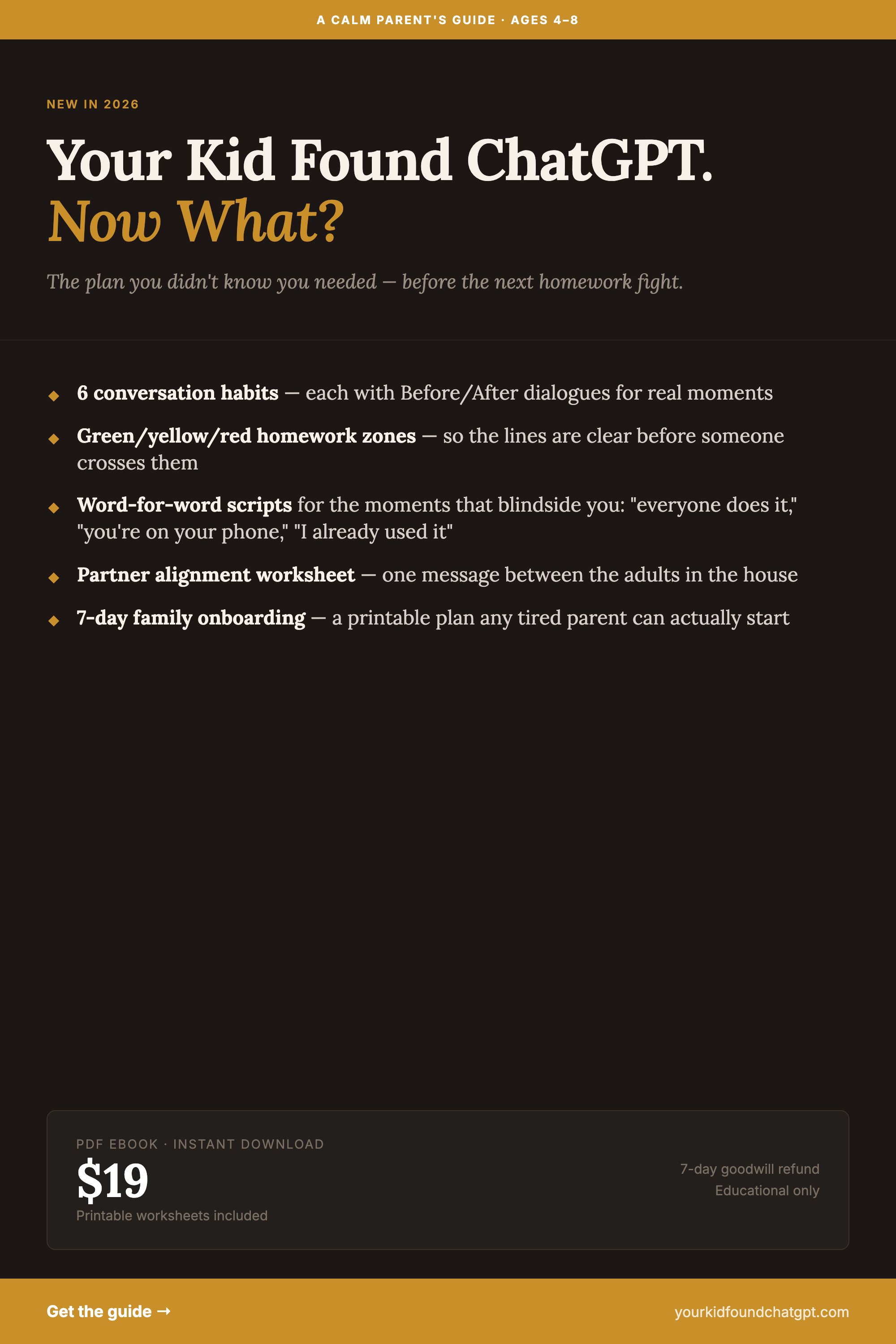
Your Kid Found ChatGPT. Now What?
Six conversation habits, word-for-word scripts, the complete green/yellow/red homework system, and a 7-day family onboarding plan. Written for parents of kids 4–8.
Get the guide — $19 →