Your kid already knows ChatGPT exists. Maybe they found it themselves. Maybe a classmate mentioned it. Maybe they saw you use it. And now they're asking you what it actually is — and your mind goes completely blank.
"It's a machine learning model trained on billions of tokens of text" is technically accurate and completely useless for a 6-year-old. What you need is an analogy — one that's honest, simple, and sets up the right instincts from the start.
Here are three that actually work, organized by age.
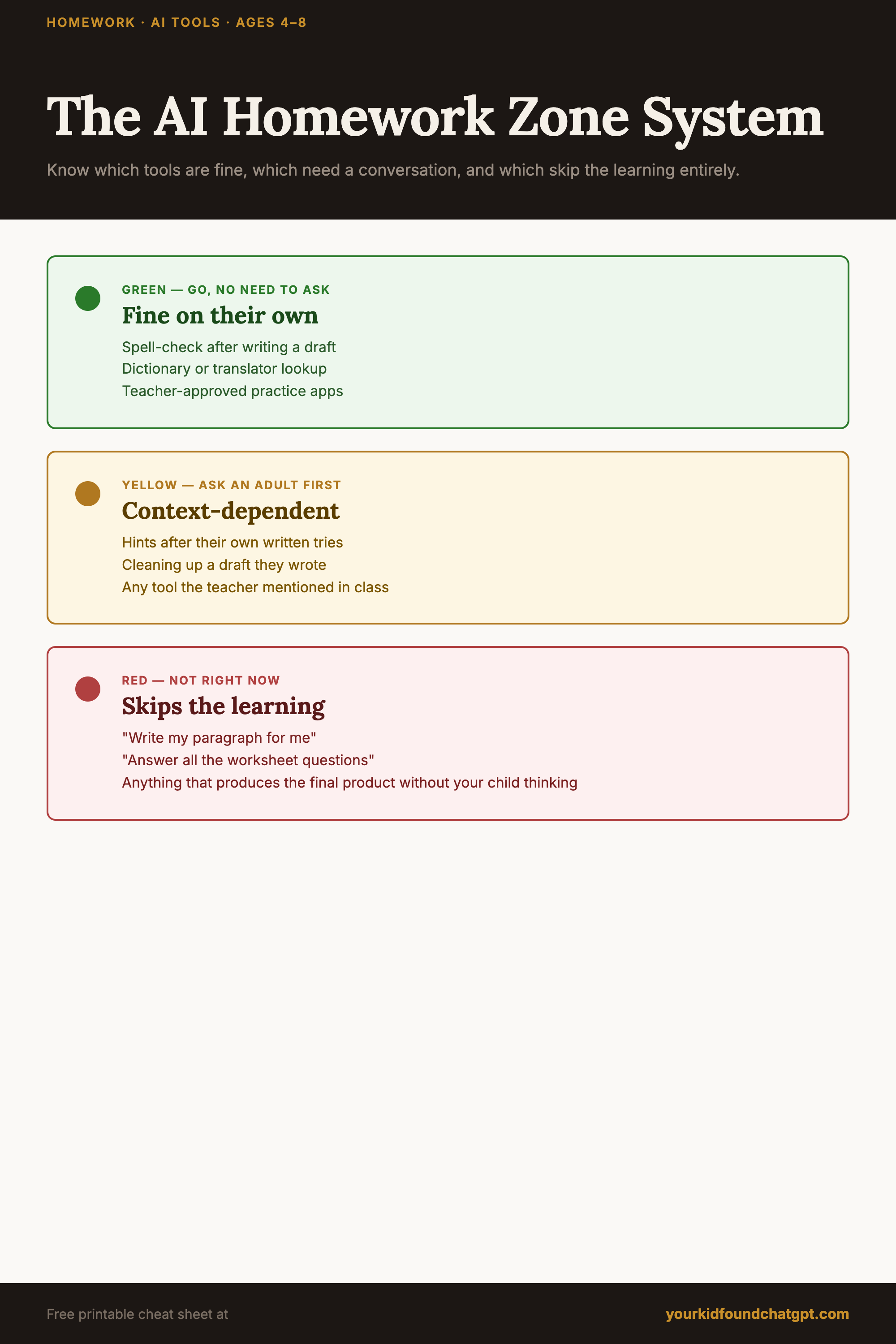
Save this for later
Pin it to your "Parenting Tips" board — the conversation will come up again.
More practical parenting + AI guides → Parenting in the Age of AI on Pinterest
Why analogies work better than explanations
Young children don't build understanding from technical definitions — they build it from comparison to things they already know. The analogy doesn't need to be perfect. It needs to be directionally honest and give your child the right instincts: what to trust, what to verify, what to come to you about.
The three analogies below are ordered by age. Use whichever fits, and don't worry about being technically complete. You're not writing a textbook — you're starting a conversation.
Three analogies that land
The very smart autocomplete
When you type a text message and your phone guesses the next word? ChatGPT is like that — but it keeps guessing, word after word after word, until it's written a whole answer. It got very good at guessing because it read an enormous number of books, websites, and stories. So it sounds smart. But it's still guessing — it doesn't actually know things the way you know your name or your teacher's name.
The library that sometimes misremembers
Imagine a library that read every book ever written — but instead of checking the books when you ask a question, it just tries to remember what it read. And sometimes it misremembers. It gets most things right, especially common things. But on specific facts — dates, names, details — it sometimes fills in gaps with something that sounds right but isn't.
This analogy is especially useful because it explains why you'd ever want to double-check something ChatGPT says, without making it sound broken or untrustworthy. It's like a very well-read person who sometimes mixes up details.
The very confident intern
Imagine hiring an intern who has read everything — every manual, every textbook, every article. They're eager, helpful, and they give you an answer immediately and confidently, every single time. That's great. But they're also new, they sometimes make things up rather than admit they don't know, and they've never actually done most of the things they're telling you how to do.
For older kids, this framing also opens a conversation about what it means to have a helper who sounds certain but isn't always right — which is a useful skill for evaluating information everywhere, not just from AI.
Get the 1-Page Cheat Sheet for Your Fridge
House rules, the homework system, and 5 word-for-word scripts for exactly these kinds of conversations. Free.
No spam. One email with the cheat sheet PDF. That's it.
The question every kid eventually asks: "Is it smarter than you?"
Prepare for this one — it usually arrives within the first week of your child knowing ChatGPT exists, and it's a trap with no good one-word answer.
"Yes" makes you seem irrelevant. "No" isn't quite honest — in certain narrow domains, ChatGPT can retrieve and synthesize information faster than any human. "It depends" is accurate but unsatisfying for a 6-year-old at bedtime.
What actually works:
"ChatGPT has read more than I ever could. But it doesn't know you, it can't tell when it's wrong, and it doesn't care what happens to you. Those things matter more than knowing a lot of facts. A calculator can do math faster than me — that doesn't make it smarter."
The calculator comparison tends to land well for kids who've already absorbed that calculators are useful tools, not thinking things. It puts AI in the same category: powerful, fast, useful — and not a replacement for a person who loves them.
The conversation to have before first use
Once you have an analogy that fits your child, use it to anchor a short conversation before the first time they use ChatGPT intentionally. It doesn't need to be a formal talk — five minutes at dinner or in the car is enough.
- The analogy — pick one from above and walk through it together.
- The double-check habit — "when ChatGPT tells us something important, we check it. Always."
- The privacy rule — "we don't type our real name, our school, or our address. Use 'a kid' or 'my family' instead."
- The come-to-me invitation — "if ChatGPT says something weird or confusing or upsetting, you tell me. No questions asked."
That last one is the most important. You want your child's first instinct when something goes sideways to be "tell a parent" — not "figure it out alone" or "don't say anything." Building that channel early, before anything goes wrong, is the most valuable thing you can do.
What to do when they come back with a follow-up question
Kids will push. "But how does it actually work?" or "What's it made of?" are common follow-ups, especially from the 8+ crowd who want the real answer.
It's okay to say "I don't fully understand it either, and that's part of why we're figuring it out together." That honesty is more valuable than a technical answer you'd have to look up anyway.
The goal of the first conversation isn't to be a complete encyclopedia on AI — it's to establish that this is something you talk about together. The questions that follow are how you build the relationship around the subject, not a test you have to pass.
Your Kid Found ChatGPT. Now What?
Six conversation habits, word-for-word scripts for the hard moments, the complete homework system, and a 7-day family onboarding plan. Written for parents of kids 4–8.
Get the guide — $19 →