Your pediatrician said two hours. The American Academy of Pediatrics has a chart. Your phone tracks it. You've been managing screen time for years — and then ChatGPT showed up, and suddenly you're not sure any of it applies.
Is an hour on ChatGPT the same as an hour of YouTube? Does the homework conversation your kid just had with an AI count against their screen time limit? Should it?
The honest answer: screen time and AI use overlap, but they aren't the same thing. Understanding the difference changes how you set limits — and which limits matter most.
What "screen time" research actually measures
When researchers raise alarms about screen time for young children, they're almost always studying passive consumption: TV, YouTube, streaming, social media scrolling. The concerns are well-documented — displaced sleep, reduced face-to-face interaction, shortened attention spans when content is fast-moving and non-interactive.
That research says almost nothing about a child having a back-and-forth text conversation about how dinosaurs went extinct. The activity looks different in the brain. It asks different things of the child.
This doesn't mean AI use is harmless. It means "screen time = bad" is too blunt a tool for what's actually happening on the screen.
Where AI use is genuinely different
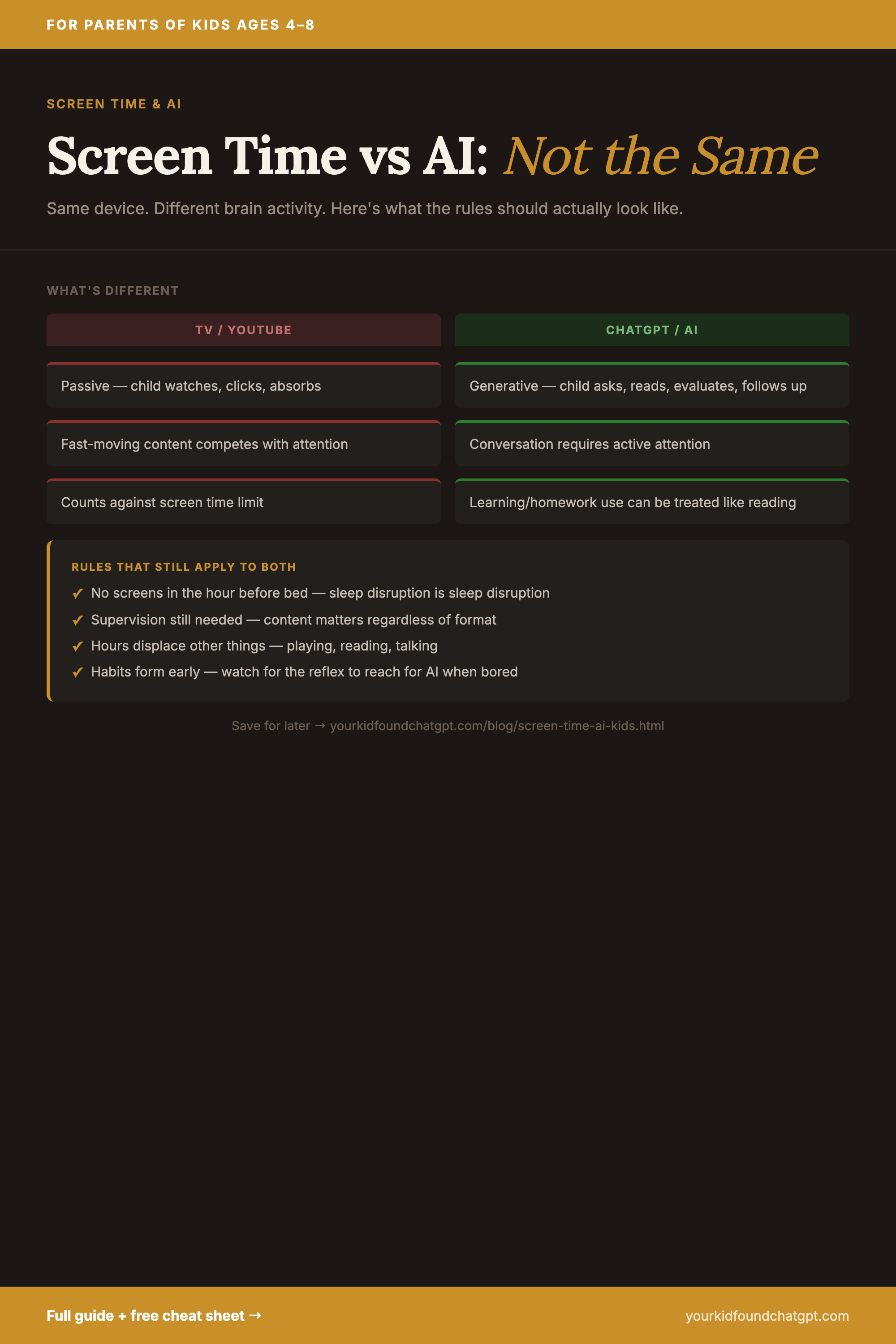
Passive screen time is consumptive — your child watches, clicks, absorbs. AI use is generative — your child has to produce a question, read a response, think about whether it makes sense, and decide what to ask next.
That loop — question, response, evaluate, follow up — is closer to reading a book or talking to a tutor than it is to watching Netflix. It requires active attention rather than surrendering to it.
For kids ages 4–8, this matters because the kind of cognitive load matters. Passive video content can compete with and degrade attention in ways that interactive conversation typically doesn't. A child who spends 30 minutes asking ChatGPT why the sky is blue is doing something meaningfully different than a child who spends 30 minutes watching unboxing videos — even if both are on the same device, in the same chair, for the same duration.
Save this graphic
Pin it to your "Parenting & Kids" board — a quick reference for when your kids ask why the AI conversation doesn't count against screen time.
More parenting + AI content on Pinterest → Parenting in the Age of AI
Where they are exactly the same
Here's the part that doesn't change just because the activity is more interactive.
Sleep disruption is sleep disruption. Blue light is blue light. Any screen — TV, YouTube, ChatGPT — used in the hour before bed disrupts melatonin production and degrades sleep quality for children. This is the one place where the old screen time rules apply directly and completely to AI use.
Displacement is real. An hour on ChatGPT is still an hour not playing outside, reading a book, or talking to a sibling. Even if the activity itself is cognitively active, it can crowd out things that are irreplaceable at this developmental stage. Hours accumulate regardless of what's happening on the screen.
Content still matters. A passive video about animals is probably fine. A passive video about violence isn't. Similarly, an AI conversation about history is fine. An AI conversation that drifts into age-inappropriate territory is not. "Interactive" doesn't mean "unsupervised."
Habits form early. If a child learns to reach for AI every time they feel curious or stuck, that reflex shapes their relationship with thinking. The same is true of reaching for YouTube. The pattern matters, not just the minutes.
Get the 1-Page Cheat Sheet for Your Fridge
The AI house rules, the green/yellow/red homework system, and 5 word-for-word scripts — all on one printable page. Free.
No spam. One email with the cheat sheet PDF. That's it.
A practical framework: treat AI like a tutor, not like TV
The most useful mental model isn't "how many minutes?" It's what mode is my child in?
| Category | Passive screen time | AI conversation |
|---|---|---|
| Brain mode | Consumption | Generation + evaluation |
| Sleep impact | Yes — same rule applies | Yes — same rule applies |
| Supervision needed | Yes | Yes |
| Displacement risk | Yes | Yes |
| Counts against 2-hr limit | Yes | Situational* |
*Situational: AI use for schoolwork, genuine curiosity, or learning can be treated more like reading than like screen time. Pure entertainment use — asking AI to write jokes, play word games endlessly — is closer to passive screen time.
This means your family might end up with a rule like: "ChatGPT for homework and learning doesn't count against your screen time limit. ChatGPT for fun counts the same as YouTube." That's a nuanced distinction a 7-year-old can understand if you explain it once, clearly.
The conversation to have
Rather than announcing a new policy, try opening it as a question. Ask your kid: "Do you think talking to ChatGPT is the same as watching a video? Why or why not?" Their answer will tell you a lot about how they think about these tools already — and it turns the rule into a shared conclusion rather than a decree.
If you need a starting point for what to put in place, the 5 AI house rules are designed for exactly this moment — simple, enforceable, built to discuss rather than post on the fridge unannounced. And if you want a system specifically for homework, the green/yellow/red homework framework draws the line between AI-as-scaffold and AI-as-shortcut.
"Same device, different brain activity. That's the insight that unlocks a smarter conversation with your kids — and with yourself — about where the limits actually belong."
The short answer
Screen time and AI use are not the same thing. The old rules cover the parts that haven't changed — sleep, supervision, displacement. But the new rules need to account for what's actually happening: a child thinking, asking, and evaluating rather than watching and scrolling.
Updating your family's framework doesn't have to be complicated. It just needs to start with a conversation instead of a countdown timer.
Your Kid Found ChatGPT. Now What?
Six conversation habits, word-for-word scripts, the green/yellow/red homework system, and a 7-day family AI onboarding plan. Written for parents of kids 4–8.
Get the guide — $19 →