It's Sunday night and the homework folder is open on the counter. The worksheet says Find three facts about your animal. Your 7-year-old is already reaching for the laptop: "Can I ask ChatGPT? The teacher didn't say we can't." And you realize you have no idea what the teacher thinks. So later you type it into a search bar: how to email my child's teacher about AI homework.
Short version: send one short email this week, before anyone has broken a rule. The guide's instruction for its school templates fits on one line: "Use these before a conflict, not after." Two of its three templates are below, word for word, plus what to say to your kid while you wait for the reply.
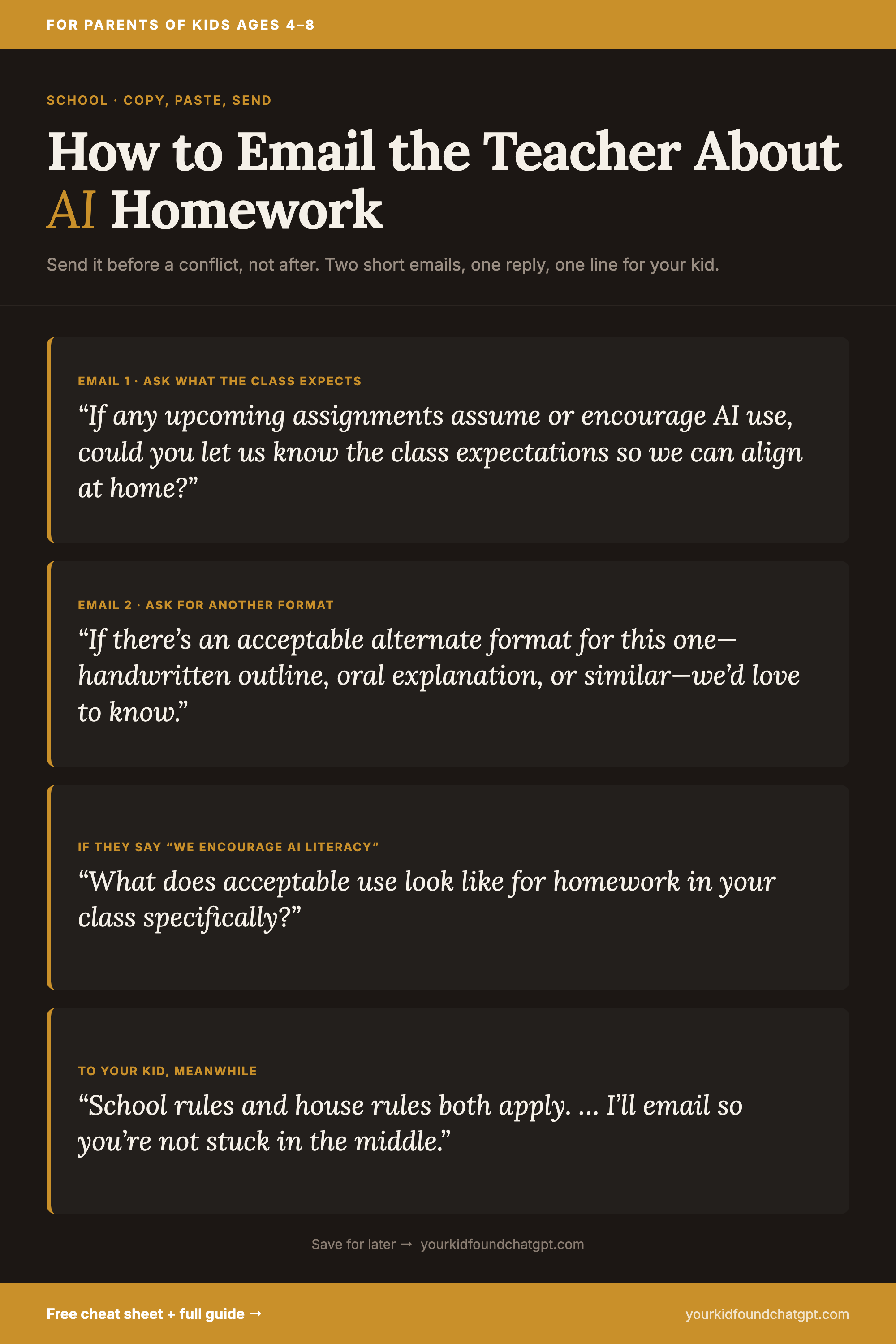
Save this graphic
Pin it to your "Parenting & Kids" board so both emails are there at the start of the next school year, or the next new teacher.
More parenting + AI content on Pinterest → Parenting in the Age of AI
Why the email goes out before the problem
The guide says the hardest homework moments are the ones where neither you nor your child is sure what the rules actually say. The school has a vague AI policy. The teacher hasn't mentioned it. Your child doesn't know if spell-check counts as cheating. You're not sure either.
That gap is where the trouble starts. The guide traces it in one line: "child uses a tool guiltily → parent discovers it → parent reacts with alarm → child feels like a bad person → nobody learned anything useful."
An email sent in October costs you three minutes. The same conversation in March, after a flagged book report, is the one in our article on what to do after your kid used ChatGPT for homework. Same teacher, very different tone.
Template 1: ask what the class expects
This is the one most families need. It tells the teacher your approach in one sentence and asks a question instead of making a demand. Fill in the brackets and send.
Subject: Homework and AI tools: our family approach
Hi [Teacher name],
We're working with [child's name] on drafting their own work before using any AI tools, for fluency and learning. If any upcoming assignments assume or encourage AI use, could you let us know the class expectations so we can align at home?
Thanks for everything you do.
[Your names]
Notice what it leaves out. It doesn't ask the teacher to ban anything or explain the school's whole AI stance. It says what happens at your house, then asks one question: what does this class expect? That's something a busy teacher can answer in two lines. And "so we can align at home" tells them you're on their side.
Get the 1-Page Cheat Sheet for Your Fridge
The 5 house rules, the green/yellow/red homework system, and 5 word-for-word scripts, all on one printable page. Free.
Free cheat sheet now, plus a few short emails with scripts. Unsubscribe anytime.
Template 2: ask for a different format
Use this one when a specific assignment assumes AI, like a worksheet that says "use any online tool" or a project built around an AI app. It asks for a different route through the same assignment, not a way out of it.
Subject: Alternate format for [assignment name]
Hi [Teacher name],
We're keeping [child's name] away from generative AI for written assignments for now. If there's an acceptable alternate format for this one (handwritten outline, oral explanation, or similar), we'd love to know. We want to make sure [child] is doing the assignment in a way that fits both our household approach and your expectations.
Thank you,
[Your names]
The phrase doing the work is "both our household approach and your expectations." You're not asking the teacher to pick a side. You're offering a version of the assignment that satisfies both.
If the reply says "we encourage AI literacy"
Sometimes the answer comes back friendly and open: the class uses AI on purpose. That isn't a fight, and it doesn't mean your house rule is wrong. The guide's reply, word for word:
"We love that. At home we're building handwriting and first-draft skills without generative text for now. What does acceptable use look like for homework in your class specifically? We want to align."
It agrees with the goal, names your line, and asks for details. Specifically is the key word. "AI literacy" can mean a teacher-led demo in class or a chatbot writing the paragraph at home, and those land in different zones. In the guide's green/yellow/red homework system, when the class requires AI use for an assignment, "the green zone expands for that assignment," but only for that assignment. The email is how you find out which assignments those are.
What to tell your kid while you wait
Back at the counter, your 7-year-old is still holding the laptop. "The teacher didn't say we can't" is one of the guide's blindside lines, and it comes with a script:
Both rules count. You take the grown-up part.
"School rules and house rules both apply. If you're in a gray zone, I'd rather you check with me than guess wrong and feel bad about it later. I'll email so you're not stuck in the middle."
The last sentence is the one that matters. A 7-year-old shouldn't be the messenger between two sets of adults, guessing which rule wins. You take that job, and they get to be a kid doing a worksheet.
Until the reply comes, the house default holds. The guide's third house norm: "No pasted school answers unless the teacher explicitly allows it for that assignment." Three facts about an animal can come from a library book tonight. If your kid comes back with "but everyone uses it," that fight has its own script.
When to send it, and when to send it again
- Early in the year, or at the start of a new unit. Before the first assignment that could go either way. If your family does a weekly check-in, the guide's "preview" question (anything coming up this week?) is a good moment to spot a big project.
- Every new teacher, every new year. As the guide notes, AI policies differ not just district to district but teacher to teacher. Last year's answer isn't this year's.
- When homework feels impossible without the tools. The guide's if/then table says to talk to the teacher and ask about load, supports, and formal accommodations if relevant. That's a different email, and an important one.
- Not in the middle of a meltdown. Write it after the kids are in bed, reread it in the morning, then send.
One exception: if your child uses assistive technology like text-to-speech for a diagnosed need, the guide treats that as a separate conversation with the school about a formal plan, not a template email.
What you're actually doing
Three sentences to a teacher sounds small. But it moves the AI question out of your kitchen at 8 p.m. and into a calm exchange between two adults who both want your kid to learn. Your child sees that rules can be checked instead of guessed, and that asking first is something grown-ups do too. That's the habit you want in place when the tools get bigger and you're not standing at the counter.
So this week: one email, one line for your kid, one library book. Then wait for the reply.
Frequently asked questions
How do I email my child's teacher about AI and homework?
Keep it to three or four sentences and send it before there is a problem. State your family's approach in one line, for example that your child drafts their own work before using any AI tools. Then ask one question: if upcoming assignments assume or encourage AI use, what does the class expect? Close with thanks. Skip asking the teacher to defend the school's whole AI policy. A short, specific question gets a short, specific answer.
Is it rude to ask a teacher about their AI policy?
No. Asking early is the opposite of rude, because it prevents a harder conversation later. Frame it as wanting to align at home, not as a challenge to how the teacher runs the class. A phrase like "so we can align at home" tells the teacher you are on the same side. The email that lands badly is the one sent in a hurry after a flagged assignment.
What if the teacher encourages AI but I don't want my child using it at home?
Agree with the goal, then ask for specifics. Something like: "We love that. At home we're building handwriting and first-draft skills without generative text for now. What does acceptable use look like for homework in your class specifically?" AI literacy can mean anything from a teacher-led demo to a chatbot writing a paragraph. Once you know the exact use, you can decide whether it fits your house rules or ask for an alternate format.
What should I tell my child if the teacher never said AI was off-limits?
Tell them both sets of rules apply, and that you will handle the grown-up part: "School rules and house rules both apply. If you're in a gray zone, I'd rather you check with me than guess wrong and feel bad about it later. I'll email so you're not stuck in the middle." Until the teacher replies, keep your house default: your child does the work themselves, and nothing gets pasted in.
Your Kid Found ChatGPT. Now What?
Six conversation habits with word-for-word scripts labeled by age, the green/yellow/red homework system, the moments that blindside you (the first device, after bedtime, the homework that wrote itself), and 16 printable worksheets. A 121-page PDF for parents of kids ages 4 to 12.
Get the guide, $19 →