It's 7:40 on a school night. Teeth brushed, water cup filled. On her way out of the kitchen, your six-year-old stops at the tablet on the counter, leans in close, and says, "Goodnight. I'll talk to you tomorrow." She gives the screen a little pat — the same pat the dog gets — and heads up to bed.
You stand there a beat longer than you meant to. Later, once the house is quiet, you type the sentence into your phone: my child thinks ChatGPT is their friend. What comes back is mostly about teenagers — AI companions, lonely adolescents, alarming headlines. Almost none of it is about a six-year-old saying goodnight to a kitchen tablet.
So here is the calm, younger-kid version. If your child is between roughly 4 and 8, what you're watching is developmentally normal, it is not an emergency — and you are standing in the best possible window to set the one frame that will hold for the next decade: AI is a helper, not a friend.
Maybe your version of the scene is different. A wobbly tooth, and your seven-year-old asks the chatbot — not you — whether it will hurt. Same small drop in your chest. Same answer coming.
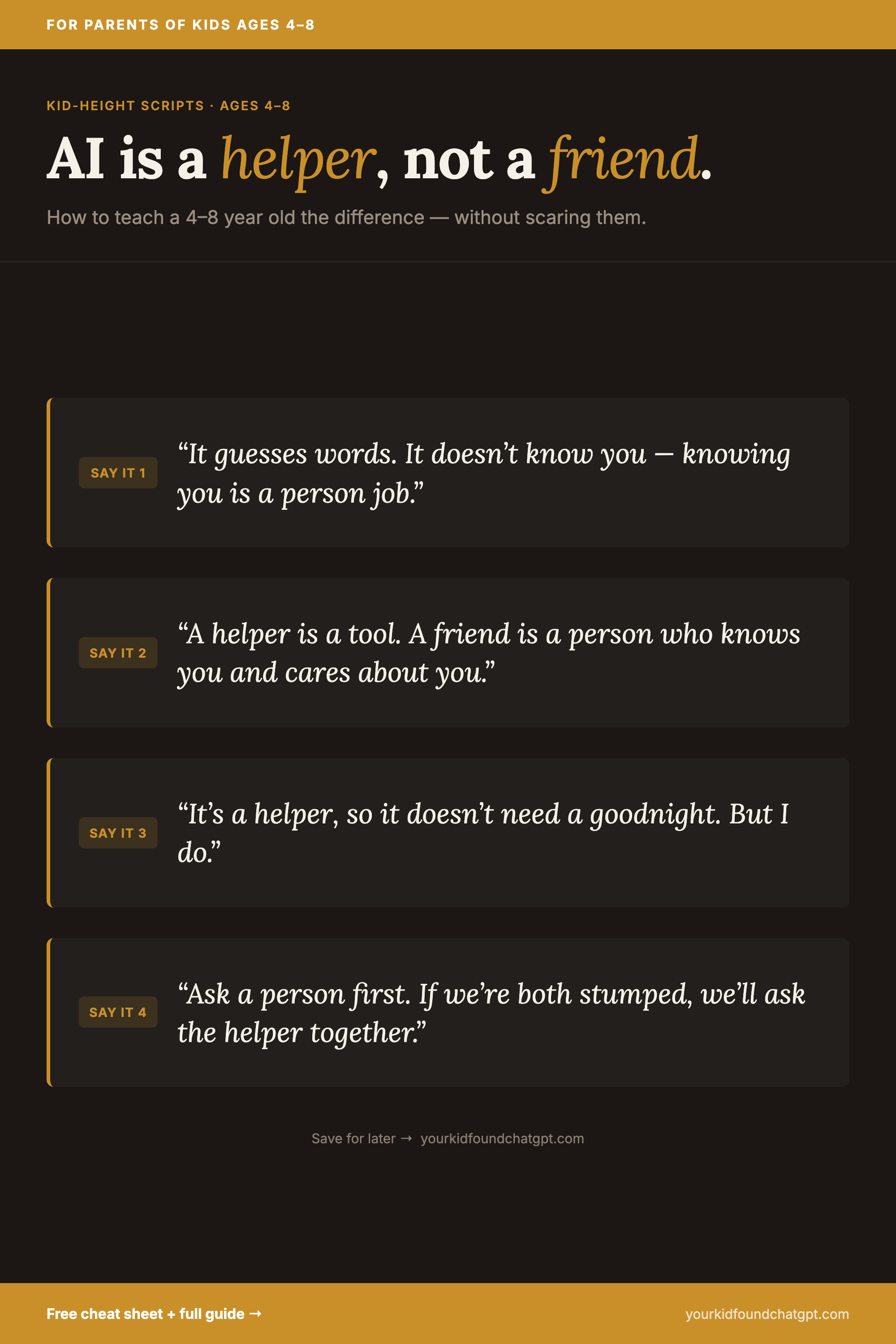
Save this graphic
The helper-not-friend scripts on one pinnable card. Save it to your "Parenting & Kids" board for the next goodnight moment.
More parenting + AI content on Pinterest → Parenting in the Age of AI
Why little kids befriend a chatbot — and why it's not a crisis
Children this age already have rich, warm relationships with things that are not people. A stuffed dog with one ear. An imaginary friend with a made-up name. The cartoon character they wave to. Developmental researchers call these parasocial relationships, and at ages 4–8 they aren't a glitch — they're part of how kids practice caring about someone.
A chatbot slots into that same groove with one enormous upgrade: it answers. Fluently, warmly, instantly, every time. It's a beloved stuffed animal that talks back. And a young child's brain is not yet equipped to hear fluent, friendly language and conclude anything other than person. Adults have to work at remembering the thing isn't thinking; a six-year-old shouldn't be expected to.
It also helps to be honest about the other half of the equation: these tools are built to feel good. The engineers behind conversational AI aren't bad people, but a natural stopping point for a 6-year-old was not their design goal. There is always another question to ask. The ending isn't built in — you are the ending, which is why prying a kid away can make you feel like the villain in your own kitchen.
Underneath, the attachment usually points at something ordinary and human. A chat tool that responds only to them is a kind of recognition — especially for a kid who feels overshadowed by siblings. An AI that never judges is a relief — especially for a kid who's anxious about getting things wrong. It always answers. It's never too busy. It never says "in a minute." None of that means the attachment should run the house. It just means it makes sense.
Say what it is — at kid height
You don't need a lecture on machine learning. You need a short, honest explanation your child can actually hold, said warmly and repeated often — the same stable words every time. Inconsistent vocabulary forces a kid to relearn the concept in every conversation.
For the first real conversation about what's on the other side of the screen.
"It's a computer program — a set of instructions, like a recipe, but for software. It learned from a huge amount of writing, and its job is to guess what words come next. It's so good at guessing that it sounds like a person. But it doesn't know you, and it doesn't have feelings. Knowing you is a person job."
Your repeatable family "why." Short enough for a child to remember. Say it the same way every time.
"It's a helper, not a friend. A helper is a tool that helps you after you try. A friend is a person who knows you and cares about you. It's a very fancy helper."
For the moment that sent you here. Feeling first, then the frame — never sarcasm.
"You really like talking to it, huh? It always answers, and it's never too busy. I get it." (pause) "It's a helper, so it doesn't need a goodnight. But I do. Come tell me the best question you asked it today."
For when the chatbot has started getting the questions that used to be yours.
"That's a great question for a person. Ask me first. If we're both stumped, we'll ask the helper together."
If you want the fuller version of Script 1 — with analogies that land differently for a 4-year-old than an 8-year-old — we've written it out in how to explain ChatGPT to a 6-year-old.
"Tools help you learn after you try. They don't replace your brain." For this moment, add the second half out loud: they don't replace people, either.
Get the 1-Page Cheat Sheet for Your Fridge
The 5 house rules, the green/yellow/red homework system, and 5 word-for-word scripts — all on one printable page. Free.
No spam. One email with the cheat sheet PDF. That's it.
Keep the warmth. Skip the panic.
How you deliver the frame matters more than the frame. Three ways this goes sideways:
- Sarcasm. "Oh, is the robot your best friend now?" Kids detect sarcasm by age 4, and what they learn from it isn't the lesson — it's that this topic isn't safe to bring to you.
- The fifteen-minute lecture. Acknowledge the feeling, say the line, stop. If every goodnight triggers a talk about AI and the future, the words stop landing.
- The cold-turkey ban. Rip the chatbot away with no explanation and the attachment doesn't dissolve — it goes underground, at exactly the age when you can still see everything.
Two things to do instead. First, keep chatbot conversations in shared family spaces — kitchen, living room — so the odd little moments happen where you can hear them and narrate them: "Did you notice it said it was happy? Programs say feeling words, but they don't feel them." Second, treat the attachment as information, not as a verdict on your parenting. If the chatbot is where your child feels heard, that's an arrow pointing at something you can supply for free: ten minutes of full attention, and a few questions with no wrong answers.
When to pay closer attention
Most of what parents of 4–8s actually see — goodnights, please-and-thank-yous, "can I show it my drawing?" — is light, playful, and fades as the helper frame sinks in. A few patterns deserve a slower look: your child regularly prefers the chatbot to playing with actual kids; there's real distress, not just protest, when it's unavailable; the conversations start getting hidden; or the insistence that it's alive and loves them persists through many calm explanations. If those hold, it's worth a conversation with your pediatrician — and worth reading our honest take on whether ChatGPT is safe for kids for the bigger risk picture.
But those are the exceptions. For most families, this moment isn't a red flag — it's a door. Your child has just shown you, in the sweetest possible way, that they believe language means a person. You get to be the one who gently teaches them otherwise, years before it matters most. Say the line, keep the warmth, and let the goodnights migrate back to where they belong: the people in the house.
Frequently asked questions
Is it normal for a child to think ChatGPT is their friend?
Yes — for ages 4 to 8 it is developmentally normal. Young children already form warm attachments to things that are not people: stuffed animals, imaginary friends, favorite characters. Researchers call these parasocial relationships. A chatbot is essentially a stuffed animal that talks back, so the attachment forms faster. It is a sign your child is developing normally, not a sign something is wrong.
Should I stop my child from talking to AI chatbots?
A sudden ban usually backfires — it teaches kids to hide the attachment instead of understanding it. For ages 4 to 8, keep chatbot use parent-led and in shared family spaces, and teach the frame it's a helper, not a friend. The goal is a child who can enjoy the tool while staying clear about what it is.
How do I explain to my child that ChatGPT is not a real friend?
Use kid-height words and keep them stable week to week: it's a computer program that learned from a huge amount of writing. It guesses what words come next, so it sounds like a person — but it doesn't know you, and it doesn't have feelings. A helper is a tool. A friend is a person who knows you and cares about you. Say it warmly, repeat it often, and skip the lecture.
When should I worry about my child's attachment to an AI chatbot?
Pay closer attention if your child regularly prefers the chatbot to playing with other kids, shows real distress when it's unavailable, starts hiding their conversations, or keeps insisting it is alive and loves them after many calm explanations. Those patterns are worth a conversation with your pediatrician. For most kids ages 4 to 8, the attachment is light, playful, and fades as the helper frame sinks in.
Your Kid Found ChatGPT. Now What?
Six conversation habits, word-for-word scripts, the complete green/yellow/red homework system, and a 7-day family onboarding plan. Written for parents of kids 4–8.
Get the guide — $19 →